


Page 175 - Silence in Intercultural Communication
P. 175
162  Silence in Intercultural Communication


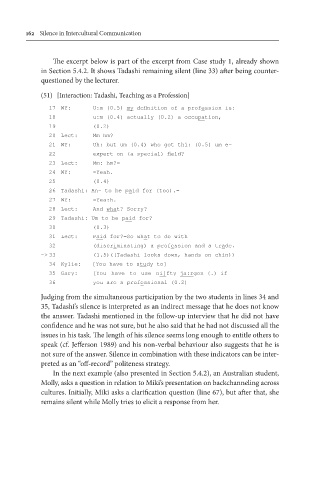
                The excerpt below is part of the excerpt from Case study 1, already shown
             in Section 5.4.2. It shows Tadashi remaining silent (line 33) after being counter-
             questioned by the lecturer.

             (51)   [Interaction: Tadashi, Teaching as a Profession]

             	 	17		WY:						U:m	(0.5)	my definition of a profession	is:
             	 	18										u:m	(0.4)	actually	(0.2)	a	occupation,
             	 	19										(0.2)
             	 	20		Lect:				Mm	hm?
             	 	21		WY:						Uh:	but	um	(0.4)	who	got	thi:	(0.5)	um	e-
             	 	22										expert on (a special) field?
             	 	23		Lect:				Mm:	hm?=
             	 	24		WY:						=Yeah.
             	 	25										(0.4)
             	 	26		Tadashi:	An-	to	be	paid	for	(too).=
             	 	27		WY:						=Yea:h.
             	 	28		Lect:				And	what?	Sorry?
             	 	29		Tadashi:	Um	to	be	paid	for?
             	 	30										(0.3)
             	 	31		Lect:				Paid	for?=So	what	to	do	with
             	 	32										(discriminating)	a	profession	and	a	trade.
             ->	33										(1.5)((Tadashi	looks	down,	hands	on	chin))
             	 	34		Kylie:			[You	have	to	study	to]
             	 	35		Gary:				[You			have			to			use			ni]fty	ja:rgon	(.)	if
             	 	36										you	are	a	professional	(0.2)
             Judging from the simultaneous participation by the two students in lines 34 and
             35, Tadashi’s silence is interpreted as an indirect message that he does not know
             the answer. Tadashi mentioned in the follow-up interview that he did not have
             confidence and he was not sure, but he also said that he had not discussed all the
             issues in his task. The length of his silence seems long enough to entitle others to
             speak (cf. Jefferson 1989) and his non-verbal behaviour also suggests that he is
             not sure of the answer. Silence in combination with these indicators can be inter-
             preted as an “off-record” politeness strategy.
                In the next example (also presented in Section 5.4.2), an Australian student,
             Molly, asks a question in relation to Miki’s presentation on backchanneling across
             cultures. Initially, Miki asks a clarification question (line 67), but after that, she
             remains silent while Molly tries to elicit a response from her.

