


Page 176 - Silence in Intercultural Communication
P. 176
Chapter 5.  Performance and perceptions of silence  163


             (52)   [Interaction: Aya]

             	 	62			Molly:			Do-	do	we:	lik-	do	generally	um:	(0.6)	I
             	 	63											don’t	know	how	can	I	say	it	right	do	Western
             	 	64											people:	(0.3)	do	their	ow-	do	their	own
                65           fill-in:	stuff?
             	 	66											(0.2)
             ->	67			Miki:				Do	their,	sorry?
             	 	68											(0.4)
             	 	69			Molly:			L-	like	um	(0.4)	um?	hu(h)h	(0.2)	li-	do	we
             	 	70											(0.2)	instead	of	um::	li-	>I	don’t	know<	we
             	 	71											have	pauses	instead	of	um:	(0.6)	I	don’t	know
             	 	72											we	have	pauses	instead	of	(0.5)	um	(0.2)
             	 	73											the:	(0.2)	those	(									)	you	know	saying
             	 	74											something		with:	nodding	or	whatever,	(.)	do
                75           we fill	it	in	instead?	(0.2)	more?
             ->	76											(3.6)
             	 	77			Molly:			Er	the	are	the:se	backchannel:s(0.4)um(0.2)
             	 	78											after: like specifically a:fter	sentences	but
             	 	79											the	person	keeps(.)the	speaker	keeps	talking?
             ->	80											(1.2)
             	 					((Lect	makes	a	comment	on	the	concept	of	backchanneling))
             	 	133		Molly:			But	that-	it-	like	how-	>I	don’t	know,<	(.)
             	 	134										i-	is	there:	(0.4)	do	Westerners do you find
             	 	135										Westerners	do	that?
             	 	136										(4.2)	((after	2.5,	shakes	her	head))
             	 	137		Miki:				I	really	don’t	(know)	(								).
             	 	138										((looks	down	on	the	paper.
             	 	139										Molly	nods	4	times-	1.2))
             	 	140										(6.0)
             	 	141		Lect:				It’s	really	(quite	a)	dramatic	difference,(.)
             	 	142										(those)	(														)

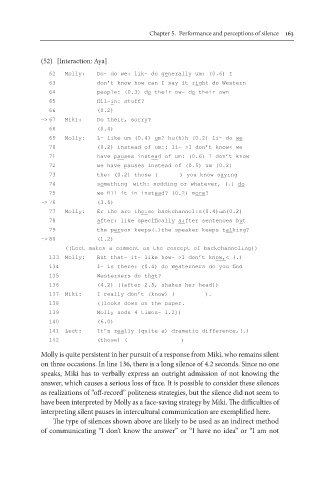
             Molly is quite persistent in her pursuit of a response from Miki, who remains silent
             on three occasions. In line 136, there is a long silence of 4.2 seconds. Since no one
             speaks, Miki has to verbally express an outright admission of not knowing the
             answer, which causes a serious loss of face. It is possible to consider these silences
             as realizations of “off-record” politeness strategies, but the silence did not seem to
             have been interpreted by Molly as a face-saving strategy by Miki. The difficulties of
             interpreting silent pauses in intercultural communication are exemplified here.
                The type of silences shown above are likely to be used as an indirect method
             of communicating “I don’t know the answer” or “I have no idea” or “I am not

