


Page 280 - Social Marketing for Public Health Global Trends and Success Stories
P. 280
57977_CH11_final.qxd:Cheng  11/5/09  4:44 PM  Page 253


                                                        The Reproductive Health Crisis in Kazakhstan  253


                    of nearly two abortions (1.8) in their lifetimes. In the capital city of Almaty, the num-
                    ber of abortions was almost double the national rate, with women there having a life-
                    time average of three (USAID/Macro International, 1995; see Table 11-1).
                       The data also indicated a strong desire for family planning and need for con-
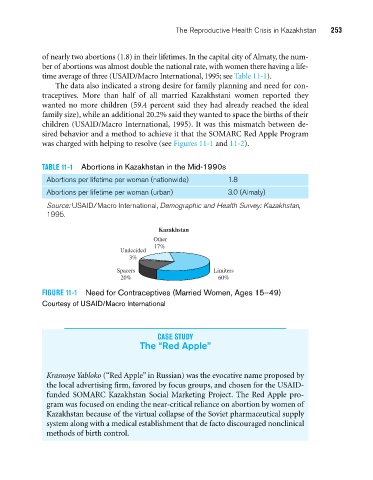
                    traceptives. More than half of all married Kazakhstani women reported they
                    wanted no more children (59.4 percent said they had already reached the ideal
                    family size), while an additional 20.2% said they wanted to space the births of their
                    children (USAID/Macro International, 1995). It was this mismatch between de-
                    sired behavior and a method to achieve it that the SOMARC Red Apple Program
                    was charged with helping to resolve (see Figures 11-1 and 11-2).


                    TABLE 11-1 Abortions in Kazakhstan in the Mid-1990s
                     Abortions per lifetime per woman (nationwide)    1.8
                     Abortions per lifetime per woman (urban)         3.0 (Almaty)

                     Source: USAID/Macro International, Demographic and Health Survey: Kazakhstan,
                     1995.

                                                   Kazakhstan
                                                  Other
                                                  17%
                                         Undecided
                                           3%
                                        Spacers                   Limiters
                                         20%                       60%
                    FIGURE 11-1 Need for Contraceptives (Married Women, Ages 15–49)
                    Courtesy of USAID/Macro International


                                                   CASE STUDY
                                              The “Red Apple”


                     Krasnoye Yabloko (“Red Apple” in Russian) was the evocative name proposed by
                     the local advertising firm, favored by focus groups, and chosen for the USAID-
                     funded SOMARC Kazakhstan Social Marketing Project. The Red Apple pro-
                     gram was focused on ending the near-critical reliance on abortion by women of
                     Kazakhstan because of the virtual collapse of the Soviet pharmaceutical supply
                     system along with a medical establishment that de facto discouraged nonclinical
                     methods of birth control.

