


Page 175 - Standard Handbook Of Petroleum & Natural Gas Engineering
P. 175
160   General Engineering and Science


                                                                        W

                               (a)

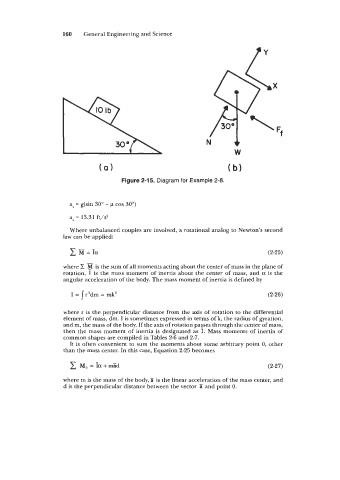
                                      Figure 2-1 5. Diagram for  Example 2-8.


                      ax = g(sin 30" - p cos 30")

                      ax = 13.31 ft/s'
                      Where unbalanced couples are involved, a rotational analog to Newton's second
                    law can be applied:

                                                                                  (2-25)

                    where  M  is the sum of all moments acting about the center of mass in the plane of
                    rotation,  I  is  the mass moment  of  inertia about the center of  mass, and a is  the
                    angular acceleration of the body. The mass moment of inertia is defined by

                       I =  r2dm = mk2                                            (2-26)


                    where r is  the perpendicular distance from the axis of  rotation to the differential
                    element of mass, dm. I is sometimes expressed in terms of k, the radius of gyration,
                    and m, the mass of the body. If the axis of rotation pas_ses through the center of mass,
                    then  the mass  moment  of  inertia is  designated  as  I. Mass  moments  of  inertia of
                    common shapes are compiled in Tables 2-6 and 2-7.
                      It is often convenient to sum the moments about some arbitrary point 0, other
                    than the mass center. In this case, Equation 2-25 becomes

                      C M, =h+m?id                                                 (2-27)
                    where m is the mass of the body, ?i is the linear acceleration of the mass center, and
                    d is the perpendicular distance between the vector  ii  and point 0.

