


Page 174 - Standard Handbook Of Petroleum & Natural Gas Engineering
P. 174
Dynamics   159

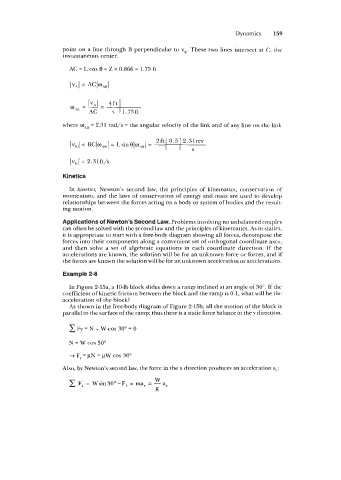
                    point  on a line through B perpendicular to v,.  These two lines intersect  at C, the
                    instantaneous center.
                      AC = L cos e = z x 0.866 = 1.73 ft


                       w,,  = -
                            AC        1.73ft
                    where wAB = 2.31 rad/s  = the angular velocity of the link and of any line on the link


                      Iv,I  = 2.31ft/s

                    Kinetics
                      In kinetics, Newton's  second  law,  the principles  of  kinematics, conservation  of
                    momentum, and the laws of conservation of energy and mass are used  to develop
                    relationships between the forces acting on a body or system of bodies and the result-
                    ing motion.

                    Applications of Newton's Second Law. Problems involving no unbalanced couples
                    can often be solved with the second law and the principles of kinematics. As in statics,
                    it is appropriate to start with a free-body diagram showing all forces, decompose the
                    forces into their components along a convenient set of orthogonal coordinate axes,
                    and then  solve a set  of  algebraic  equations in each  coordinate direction. If  the
                    accelerations are known, the solution will be for an unknown force or forces, and if
                    the forces are known the solution will be for an unknown acceleration or accelerations.
                    Example 2-8

                      In Figure 2-15a, a 10-lb block slides down a ramp inclined at an angle of 30". If the
                    coefficient of kinetic friction between the block and the ramp is 0.1, what will be the
                    acceleration of the block?
                      As shown in the free-body diagram of Figure 2-15b, all the motion of the block is
                    parallel to the surface of the ramp; thus there is a static force balance in they direction.

                         Fy  = N - W cos 30" = 0
                      N = W cos 30"

                      + F,= pN = pW cos 30"
                    Also, by Newton's second law, the force in the x direction produces an acceleration ax:

                                                W
                         Fx = W~in30O-F~ =ma,  =-a,
                                                 g

