


Page 169 - Standard Handbook Of Petroleum & Natural Gas Engineering
P. 169
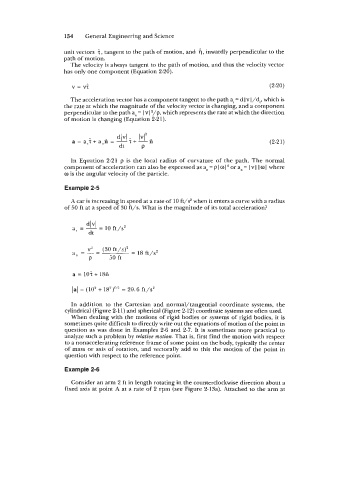
154   General Engineering and Science

                    unit vectors  .Z,  tangent to the path of motion, and fi, inwardly perpendicular to the
                    path of motion.
                      The velocity is always tangent to the path of motion, and thus the velocity vector
                    has only one component (Equation 2-20).

                       v  = vz                                                     (2-20)
                      The acceleration vector has a component tangent to the path at = d IV  l/dt, which is
                     the rate at which the magnitude of the velocity vector is changing, and a component
                    perpendicular to the path an  = I v I z/p, which represents the rate at which the direction
                    of motion is changing (Equation 2-21).

                                    dlvl  A  \VI'  -
                       a = a,Z+a,n = -z+-n                                         (2-21)
                                     dt     P

                       In  Equation  2-21 p  is  the  local  radius  of  curvature  of  the  path.  The normal
                     component of acceleration can also be expressed as an  = p I w I  or an = 1 v I I w I where
                     o is the angular velocity of the particle.

                     Example 2-5

                       A car is increasing in speed at a rate of 10 ft/s2 when it enters a curve with a radius
                     of 50 ft at a speed of 30 ft/s.  What is the magnitude of its total acceleration?

                           dlvl
                       a, = - = 10 ft/s2
                            dt


                       la1 = (lo2+ 1S2)05 = 20.6 ft/s2

                       In  addition  to  the  Cartesian  and normal/tangential  coordinate  systems, the
                     cylindrical (Figure  2-1 1) and spherical (Figure 2-12) coordinate systems are often used.
                       When dealing with the motions of rigid bodies or systems of  rigid bodies, it is
                     sometimes quite difficult to directly write out the equations of motion of the point in
                     question  as was  done in  Examples 2-6 and 2-7. It  is sometimes more  practical  to
                     analyze such a problem by relative motion. That is, first find the motion with respect
                     to a nonaccelerating reference frame of some point on the body, typically the center
                     of  mass or axis of  rotation, and vectorally add to  this the motion  of the point  in
                     question with respect to the reference point.
                     Example 2-6

                       Consider an arm 2 ft in length rotating in the counterclockwise direction about a
                     fixed axis at point A at a rate of 2 rpm (see Figure 2-13a). Attached to the arm at

