


Page 164 - Standard Handbook Of Petroleum & Natural Gas Engineering
P. 164
Dynamics   149

                      One of the simplest structures is the truss. A  truss consists of straight members
                    connected at their end points only. All loads, including the weight of  the members
                    themselves, are considered to be supported at the joints. Due to its construction and
                    the assumption of loading atjoints only, the members of a truss support only loads of
                    axial tension or axial compression. A rigid truss or a rigid structure will not collapse
                    and can  only  deform if  its  members deform. A  simple  truss  is  one that  can be
                    constructed, starting with  three members arranged in  a triangle,  by  adding new
                    members in pairs, first connecting one end of each together to form a new joint, and
                    then connecting the other ends at separate existing joints of the truss.
                      Aframe is a structure with at least one member that supports more than two forces.
                    Members of a frame may  support lateral as well as axial forces. Connections in  a
                    frame need not be  located  at the ends of  the members.  Frames, like trusses,  are
                    designed to support loads, and are usually motionless. A machine also has multiforce
                    members. It is designed to modify and transmit forces and, though it may sometimes
                    be stationary, it always includes parts that move during some phase of operation.
                      Not all structures can be fully analyzed by the methods of statics. If the number of
                    discrete equilibrium equations is equal to the number of unknown loads, then the
                    structure is  said to be statically  determinate  and rigid. If  there are more unknowns
                    than equations, then the structure is statically indeterminate. If there are more equations
                    than unknowns, then the structure is said to be statically  indeterminate  and nonrigid.
                      For further information on this subject, refer to References 1 and 2.
                                                 DYNAMICS

                      Dynamics is  the study of  the mechanics of  rigid  bodies  in motion.  It is usually
                    subdivided into kinematics, the study of the motion of bodies without reference to the
                    forces causing that motion  or to the mass of  bodies, and kinetics,  the study of  the
                    relationship between the forces acting on a body, the mass and geometry of the body,
                    and the resulting motion of the body.
                    Kinematics

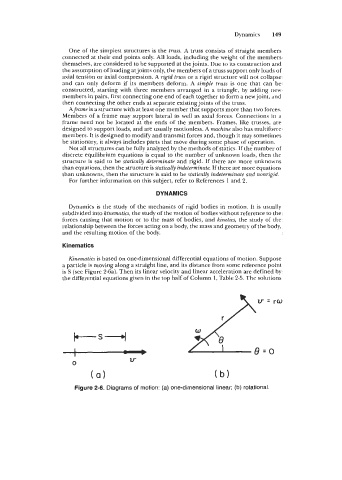
                      Kinematics is based on one-dimensional differential equations of motion. Suppose
                    a particle is moving along a straight line, and its distance from some reference point
                    is S (see Figure 2-6a). Then its linear velocity and linear acceleration are defined by
                    the differential equations given in the top half of Column 1, Table 2-5. The solutions


                        Figure 2-6. Diagrams of motion: (a) one-dimensional linear; (b) rotational.

