


Page 161 - Standard Handbook Of Petroleum & Natural Gas Engineering
P. 161
146    General Engineering and Science

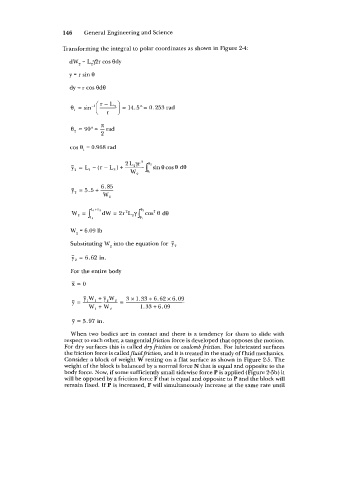
                    Transforming the integral to polar coordinates as shown in Figure 2-4:
                      dW,  = L,@r cos 8dy

                      y = r sin 0
                      dy = r COS ede


                                      = 14.5"= 0.253 rad


                       8, = 90" = 3 rad
                                2
                      cos   = 0.968 rad

                                       2L,yr3
                       7,  = L, -(r  - L,)+-   sin 8 COS 8 de
                                         W,

                                6.85
                       y,  = 5.5+-
                                WZ


                      W,  = 6.09 lb
                      Substituting W,  into the equation for 7,

                       y2 = 6.62 in.

                       For the entire body
                       -
                       x=o

                       y=  y,W, +y2W2 = 3x1.33+6.62x6.09
                            W, + W,         1.33 + 6.09
                       7 = 5.97 in.

                       When two bodies are in contact and there is a tendency  for them to slide with
                     respect to each other, a tangential friction force is developed that opposes the motion.
                     For dry surfaces this is called dry friction or coulomb friction. For lubricated  surfaces
                     the friction force is called  fluidfriction, and it is treated in the study of fluid mechanics.
                     Consider a block of weight W resting on a flat surface as shown in Figure 2-5. The
                     weight of the block is balanced by a normal force N that is equal and opposite to the
                     body force. Now, if some sufficiently small sidewise force P is applied (Figure 2-5b) it
                     will be opposed by a friction force F that is equal and opposite to P and the block will
                     remain fixed. If P is increased, F will simultaneously increase at the same rate until

