


Page 165 - Standard Handbook Of Petroleum & Natural Gas Engineering
P. 165
150   General Engineering and Science

                                                 Table 2-5
                       One-dimensional Differential Equations of Motion and Their Solutions
                             Diffacluial
                             buations   a/a = coa~tant   a = a([);  a = a(t)   a= ~v): a= NO)   a= a(s);  a= 40)
                                                                              '=[a
                      Linear


                      Rotafional   o=dB   y=q+at    Or = 0, + 1; w (t) dt


                    to  these equations are in  Columns 2-5,  for  the  cases of  constant acceleration,
                    acceleration  as  a  function  of  time, acceleration  as  a  function of  velocity,  and
                    acceleration as a function of displacement s.
                      For rotational motion, as illustrated in Figure 2-6b, a completely analogous set of
                    equations and solutions are given in the bottom half of Table 2-5. There w is called
                    the angular velocity and has units of radians/s,  and a is called angular acceleration
                    and has units of radians/s2.
                      The equations of Table 2-5 are all scalar equations representing discrete components
                    of motions along orthogonal axes. The axis along which the component w or a acts
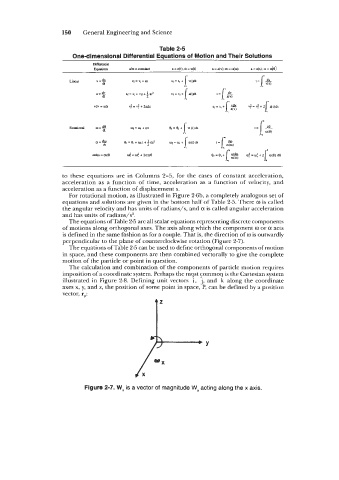
                    is defined in the same fashion as for a couple. That is, the direction of w is outwardly
                    perpendicular to the plane of counterclockwise rotation (Figure 2-7).
                      The equations of'rable 2-5 can be used to define orthogonal components of motion
                    in space, and these components are then combined vectorally to give the complete
                    motion of the particle or point in question.
                      The calculation and combination of the components of particle motion requires
                    imposition of a coordinate system. Perhaps the most SomrnoQ is the Cartesian system
                    illustrated  in Figure  2-8. Defining unit vectors  i,  j, and  k  along the coordinate
                    axes x, y, and z, the position of some point in space, P, can be defined by a position
                    vector, rp:


                           Figure 2-7. Wx is a vector of magnitude Wx acting along the x axis.

