


Page 167 - Standard Handbook Of Petroleum & Natural Gas Engineering
P. 167
152   General Engineering and Science


                                                                                    (2-17)

                       The angle  between  the  total  velocity (or any other vector) and any particular
                     coordinate axis can be calculated from the scalar product of said vector and the unit
                     vector along that axis. The scalar product is defined as

                        a  b  = a,b,  .t a,b,  + a,b,  = lallblcos0

                     where 8 is the angle between vectors a and b. Thus the angle between the velocity
                     and the x axis is
                       e,  = cos-l[  $)


                                                                                   (2-18)

                       If the  magnitude  and direction of  a vector are known, its components are  the
                     products of  the magnitude and the respective direction cosines. In the case of the
                     velocity vector, for example, the components are


                       vy = Ivplcosey                                              (2-19)

                           I
                       vZ =  v  cosez
                             PI
                     Example 2-4

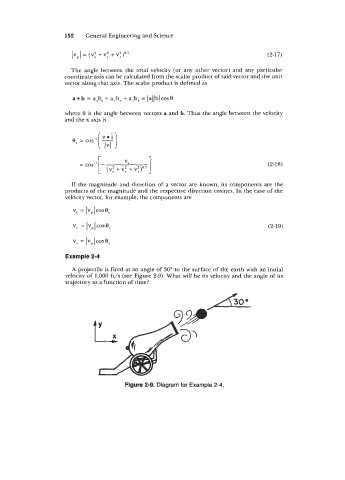
                       A projectile is fired at an angle of 30" to the surface of the earth with an initial
                     velocity of  1,000 ft/s  (see Figure 2-9). What will be its velocity and the angle of its
                     trajectory as a function of time?


                                       Figure 2-9. Diagram for Example 2-4.

