


Page 168 - Standard Handbook Of Petroleum & Natural Gas Engineering
P. 168
Dynamics   153

                   x Component: The initial velocity in the x direction is


                     vx  = 866 ft/s

                   Assuming no air friction, this velocity is constant.
                   y  Component: The initial velocity in the y direction is


                      v~<> 500 ft/s
                         =
                   In the y direction, the projectile has a constant acceleration of  -g  = -32.2  ft/sec:'.
                   Thus by  Equation 2-2, Column, 2, Table 2-5, its velocity as a function of time is

                      vv(t)  = v,~] + at = v,,  -gt
                                     32.2 ft
                          = 500 ft/S  - -
                                       S2

                   and the total velocity vector is

                      v  = 8661+(500-32.2t)j
                   The angle of the trajectory is found from Equation 2-18 as

                                                   1
                      ex = cos-'       866
                               [866* +(500-32.2t)']05~


                     It is often convenient to use some other coordinate system besides  the Cartesian
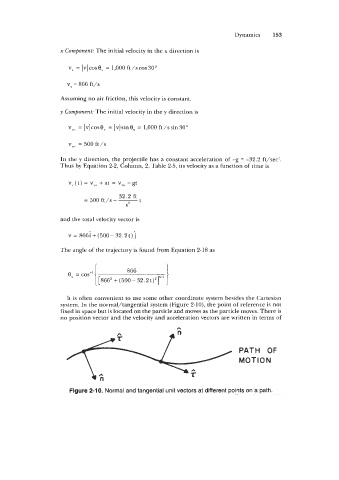
                   system. In the normal/tangential  system (Figure 2-10), the point of reference is not
                   fixed in space but is located on the particle and moves as the particle moves. There is
                   no position vector and the velocity and acceleration vectors are written in terms of
                                                      n


                                                                         PATH  OF
                                                                         MOTION


                      Figure 2-10. Normal and tangential unit vectors at different points on a path.

