


Page 173 - Standard Handbook Of Petroleum & Natural Gas Engineering
P. 173
158   General Engineering and Science


                      a,  = -0.3621 ft/s2
                      When  looking for  the  velocities  of  points  on  a  rigid  body,  the  method  of
                    instantaneous centers can often be used. If the velocity of two points on the body are
                    known, those points and all other points on the body can be considered to be rotating
                    with  the  same angular velocity about  some motionless central  point. This central
                    point  is called the instantaneous  center of  zero velocity. The instantaneous center
                    generally moves through space as a function of time and has acceleration. It does not
                    represent a point about which acceleration may be determined.
                    Example 2-7

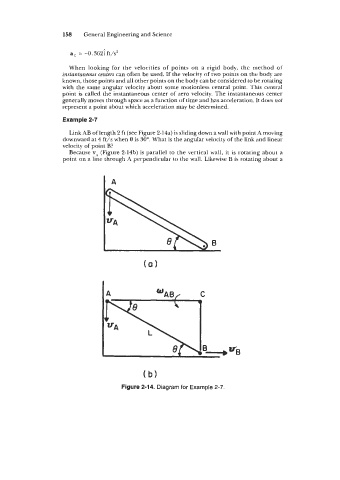
                      Link AB of length 2 ft (see Figure 2-14a) is sliding down a wall with point A moving
                    downward at 4 ft/s  when 0 is 30". What is the angular velocity of the link and linear
                    velocity of point B?
                      Because v,  (Figure 2-14b) is parallel  to the vertical  wall, it is  rotating  about a
                    point on a line through A perpendicular to the wall. Likewise B is rotating about a


                                             (b)

                                      Figure 2-1 4. Diagram for Example 2-7.

