


Page 236 - Standard Handbook Of Petroleum & Natural Gas Engineering
P. 236
Thermodynamics   209


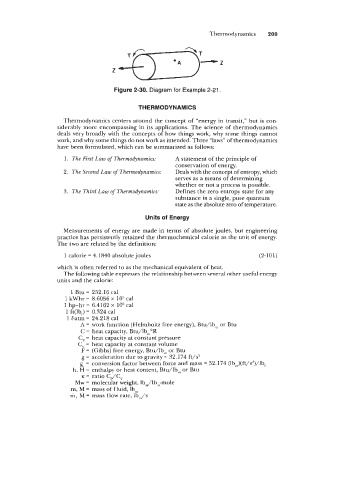
                                    Figure 2-30. Diagram for Example 2-21


                                           THERMODY NAMlCS
                    Thermodynamics centers around  the concept of  “energy in  transit,” but is  con-
                  siderably  more encompassing in  its  applications.  The science of  thermodynamics
                   deals very broadly  with the concepts of how things  work, why  some things  cannot
                  work, and why some things do not work as intended. Three “laws”  of thermodynamics
                  have been formulated, which can be summarized as follows:
                     1.  The First Law of  Thermodynamics:   A statement of the principle of
                                                      conservation of energy.
                    2.  The Second Law of Thermodynamics:   Deals with the concept of entropy, which
                                                      serves as a means of determining
                                                      whether or not a process is possible.
                    3.  The Third Law of Thermodynamics:   Defines the zero entropy state for any
                                                      substance in a single, pure quantum
                                                      state as the absolute zero of temperature.
                                             Units of Energy

                    Measurements of  energy  are made in  terms of  absolute joules, but engineering
                  practice has persistently  retained the thermochemical calorie as the unit of  energy.
                  The two are related by the definition:
                     1 calorie = 4.1840 absolute joules                         (2-101)
                  which is often referred to as the mechanical equivalent of heat.
                    The following table expresses the relationship between several other useful energy
                  units and the calorie:

                       1 Btu = 252.16 cal
                     1 kWhr = 8.6056 x  lo9 cal
                     1 hp-hr  = 6.4162 x 10 cal
                     1  ft(lb,) = 0.324 cal
                     1 batm = 24.218 cal
                         A = work function (Helmholtz free energy), Btu/lb,,, or Btu
                          C = heat capacity, Btu/lbnloR
                         C, = heat capacity at constant pressure
                         C, = heat capacity at constant volume
                          F = (Gibbs) free energy, Btu/lb,” or Btu
                          g = acceleration due to gravity = 32.174 ft/s‘
                         g, = conversion factor between force and mass = 32.174 (lbr,,)(ft/s‘)/lb,
                       h, H = enthalpy or heat content, Btu/lb,,, or Btu
                          K  = ratio CJC,
                        Mw = molecular weight, lbJlbm-mole
                       m, M = mass of fluid, lbm
                      m, M = mass flow rate, lb,/s

