


Page 238 - Standard Handbook Of Petroleum & Natural Gas Engineering
P. 238
Thermodynamics    2 1 1

                       Q = A(U + PV) = H,  - HA = AH  [constant pressure process]   (2-  108)
                     Enthalpy is a property of the system independent of the path selected. Processes can
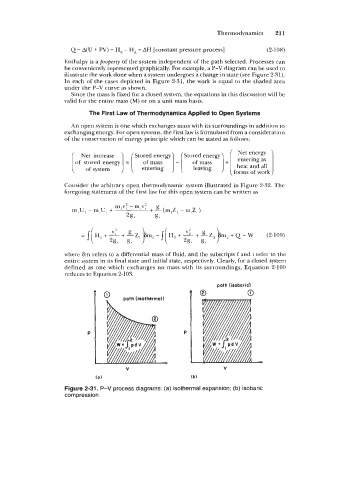
                    be conveniently represented graphically. For example, a P-V  diagram can be used to
                    illustrate the work done when a system undergoes a change in state (see Figure 2-3  1).
                     In each of  the cases depicted  in Figure 2-31, the work  is equal to the shaded area
                    under the P-V  curve as shown.
                       Since the mass is fixed for a closed system, the equations in this discussion will be
                    valid for the entire mass (M) or on a unit mass basis.

                            The First Law of Thermodynamics Applied to Open Systems
                      An open system is one which exchanges mass with its surroundings in addition to
                    exchanging energy. For open systems, the first law is formulated from a consideration
                    of the conservation of energy principle which can be stated as follows:
                                                                                z;,
                          Net  increase   Stored energy   Stored energy   Net energy
                       [of  stored  energy)  = [  of mass  1 - [  7:s; 1 + [  ~~~~~~
                           of  system       entering
                                                                        forms of work
                    Consider the arbitrary open thermodynamic system illustrated in Figure 2-32. The
                    foregoing statement of the first law for this open system can be written as


                                                                    m2  + Q - W   (2-109)


                    where 6m refers to a differential mass of fluid, and the subscripts f and i refer to the
                    entire system in its final state and initial state, respectively. Clearly, for a closed system
                    defined as  one which  exchanges no mass with  its surroundings, Equation 2-109
                    reduces to Equation 2-103.

                                                                   path (isobaric)
                                      path (isothermal)


                           P                             P


                                       V                             V
                              (0)                          (bl
                     Figure 2-31. P-V  process diagrams: (a) isothermal expansion; (b) isobaric
                    compression.

