


Page 240 - Standard Handbook Of Petroleum & Natural Gas Engineering
P. 240
Thermodynamics   2 13

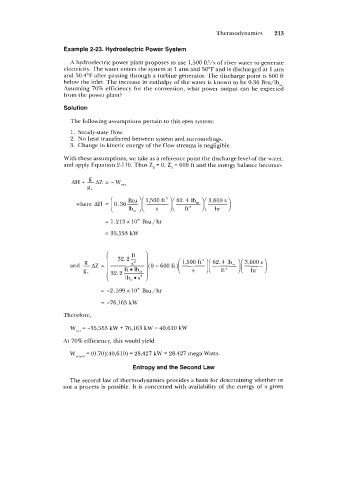
                     Example 2-23. Hydroelectric Power System
                      A hydroelectric power plant proposes to use 1,500 ft’/s  of river water to generate
                    electricity. The water enters the system at 1 atm and 50°F and is discharged at 1 atm
                    and 50.4”F after passing through a turbine generator. The discharge point is 600 ft
                    below the inlet. The increase in enthalpy of the water is known to be 0.36 Btu/lb,,,.
                    Assuming 70% efficiency  for the conversion, what power output can be expected
                    from the power plant?

                    Solution
                      The following assumptions pertain to this open system:
                       1.  Steady-state flow.
                       2.  No heat transferred between system and surroundings.
                      3.  Change in kinetic energy of the flow streams is negligible.
                    With these assumptions, we take as a reference point the discharge level of the water,
                    and apply Equation 2-110. Thus Z,  = 0, Z, = 600 ft and the energy balance becomes
                            g
                       AH+-AZ    =-W,,,
                            g<
                                                         fti  j(1j
                                             1,500 ft‘   62.4 lb,   3,600 s
                        whereAH  =[0.36E)(y)(
                                 = 1.213~ 10’  Btu/hr

                                 = 35,553 kW


                                         ft
                                     32.2,                        62.4 lb,  )(%)
                      and  -AZ g  =I ft  lb,  ](0-600ft)[7)(  1,500 ft’   ft3
                          gc       32.2
                                       Ib,  s2
                                       ~
                                = -2.599~ lo8 Btu/hr

                                = -76,163 kW
                    Therefore,

                      W,,eL  -35,553 kW  + 76,163 kW  = 40,610 kW
                    At 70% efficiency, this would yield
                           = (0.70)(40,610) = 28,427 kW = 28.427 mega-Watts.

                                         Entropy and the Second Law

                      The second law of thermodynamics provides a basis for determining whether or
                    not a process is possible. It is concerned with availability of the energy of a given

