


Page 243 - Standard Handbook Of Petroleum & Natural Gas Engineering
P. 243
2 16   General Engineering and Science

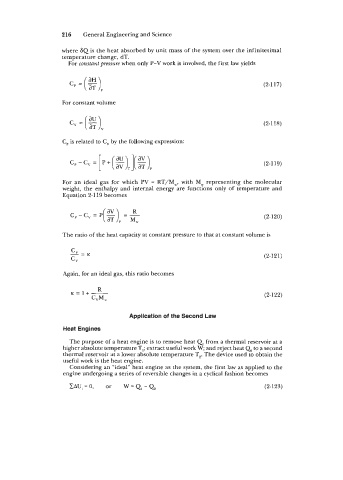
                    where SQ  is the heat absorbed by unit mass of the system over the infinitesimal
                    temperature change, dT.
                      For constant pressure when only P-V  work is involved, the first law yields
                      CP  = (S)                                                  (2-117)


                    For constant volume
                      cv = (S)                                                   (2-1%)


                    C,  is related to Cv by the following expression:
                      CP  - cv = [ P + (3]( g)p                                   (2-119)


                    For  an  ideal  gas  for which  PV  = RT/Mw,  with  Mw representing the  molecular
                    weight, the  enthalpy  and internal energy  are functions only of  temperature  and
                    Equation 2-1 19 becomes

                       c,-cv=P(g)  =- R
                                                                                  (2-1 20)
                                     P   M,
                    The ratio of the heat capacity at constant pressure to that at constant volume is


                                                                                  (2-121)


                    Again, for an ideal gas, this ratio becomes
                               R
                       lc=l+-                                                     (2-1 22)
                             C”M,


                                         Application of the Second Law
                    Heat Engines
                      The purpose of a heat engine is to remove heat Q, from a thermal reservoir at a
                    higher absolute temperature T,; extract useful work W; and reject heat Q, to a second
                    thermal reservoir at a lower absolute temperature T,.  The device used to obtain the
                    useful work is the heat engine.
                      Considering an “ideal” heat engine as the system, the first law as applied to the
                    engine undergoing a series of reversible changes in a cyclical fashion becomes

                      CAUl = 0,   or   W = Q, - Q,                                (2-123)

