


Page 244 - Standard Handbook Of Petroleum & Natural Gas Engineering
P. 244
Thermodynamics    217

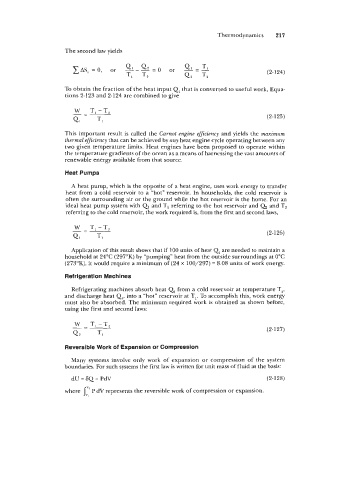
                     The second law yields


                                                                                  (2-124)

                     To obtain the fraction of the heat input Q, that is converted to useful work, Equa-
                     tions 2-123 and 2-124 are combined to give
                            Ti-T,
                        W
                       _-                                                         (2-125)
                          --
                       Qi     Ti
                     This important result  is  called  the Curnot  engine efficiency and yields the maximum
                     thermal efficiency that can be achieved by any heat engine cycle operating between any
                     two given temperature limits. Heat engines have been proposed to operate within
                     the temperature gradients of the ocean as a means of harnessing the vast amounts of
                     renewable energy available from that source.
                     Heat Pumps
                       A heat pump, which is the opposite of  a heat engine, uses work energy to transfer
                     heat from a cold reservoir  to  a  “hot” reservoir. In households,  the cold reservoir  is
                     often  the surrounding air or the ground while the hot reservoir  is the home. For an
                     ideal heat pump system with Q1 and TI referring  to the hot reservoir and Qr and T2
                     referring to the cold reservoir, the work required is, from the first and second laws,

                                                                                  (2-126)


                       Application of this result shows that if 100 units of heat Q, are needed to maintain a
                     household at 24°C (297°K) by “pumping” heat from the outside surroundings at 0°C
                     (273”K), it would require a minimum of (24 x 100/297)  = 8.08 units of work energy.

                     Refrigeration Machines
                       Refrigerating machines absorb heat Q from a cold reservoir  at temperature T,,
                     and discharge heat Q,,  into a “hot” reservoir at Ti. To accomplish this, work energy
                     must  also be absorbed. The minimum required work is  obtained as shown before,
                     using the first and second laws:

                        W  - Ti -T,
                       Q,      Ti                                                 (2-127)

                     Reversible Work of Expansion or Compression

                       Many  systems  involve  only  work  of  expansion  or compression  of  the system
                     boundaries. For such systems the first law is written for unit mass of fluid as the basis:
                       dU = SQ  - PdV                                             (2-128)
                     where s,”’ P dV represents the reversible work of compression or expansion.

