


Page 251 - Statistics II for Dummies
P. 251
Chapter 13: Forming Associations with Two-Way Tables   235


                                Checking for independence

                                between two variables

                                The previous section focuses on checking whether two specific categories are
                                independent in a sample. If you want to extend this idea to showing that two
                                entire categorical variables are independent, you must check the indepen-
                                dence conditions for every combination of categories in those variables. All of
                                them must work, or independence is lost. The first case where dependence is
                                found between two categories means that the two variables are dependent. If
                                you find that the first case shows independence, you must continue checking
                                all the combinations before declaring independence.

                                Suppose a doctor’s office wants to know whether calling patients to confirm
                                their appointments is related to whether they actually show up. The vari-
                                ables are x = called the patient (called or didn’t call) and y = patient showed
                                up for his appointment (showed or didn’t show). Here are the four conditions
                                that need to hold before you declare independence:

                                  ✓ P(showed) = P(showed|called)
                                  ✓ P(showed) = P(showed|didn’t call)
                                  ✓ P(didn’t show) = P(didn’t show|called)
                                  ✓ P(didn’t show) = P(didn’t show|didn’t call)

                                If any one of these conditions isn’t met, you stop there and declare the two
                                variables to be dependent in the sample. Only if all the conditions are met do
                                you declare the two variables independent in the sample.
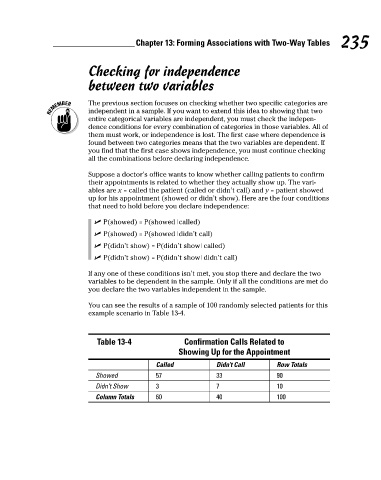
                                You can see the results of a sample of 100 randomly selected patients for this
                                example scenario in Table 13-4.


                                   Table 13-4              Confirmation Calls Related to
                                                         Showing Up for the Appointment

                                                   Called           Didn’t Call      Row Totals
                                  Showed           57               33               90
                                  Didn’t Show      3                7                10
                                  Column Totals    60               40               100


          20_466469-ch13.indd   235                                                                   7/24/09   9:48:00 AM

