


Page 253 - Statistics II for Dummies
P. 253
Chapter 13: Forming Associations with Two-Way Tables   237


                                Simpson’s Paradox in action: Video games and the gender gap
                                The best way to sort through Simpson’s Paradox is to watch it play out in
                                an example and explain all the whys along the way. Suppose I’m interested
                                in finding out who’s better at playing video games, men or women. I watch
                                males and females choose and play a variety of video games, and I record
                                whether the player wins or loses. Suppose I record the results of 200 video
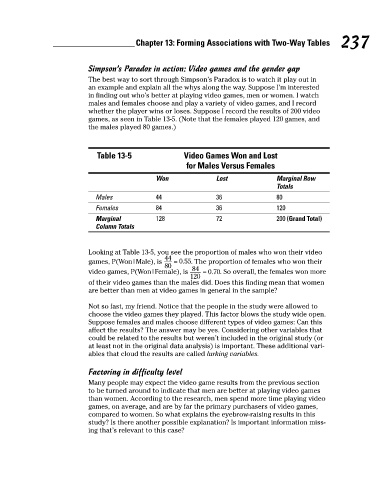
                                games, as seen in Table 13-5. (Note that the females played 120 games, and
                                the males played 80 games.)


                                   Table 13-5              Video Games Won and Lost
                                                           for Males Versus Females
                                                   Won              Lost             Marginal Row
                                                                                     Totals
                                  Males            44               36               80
                                  Females          84               36               120
                                  Marginal         128              72               200 (Grand Total)
                                  Column Totals


                                Looking at Table 13-5, you see the proportion of males who won their video
                                games, P(Won|Male), is       . The proportion of females who won their
                                video games, P(Won|Female), is       . So overall, the females won more
                                of their video games than the males did. Does this finding mean that women
                                are better than men at video games in general in the sample?
                                Not so fast, my friend. Notice that the people in the study were allowed to
                                choose the video games they played. This factor blows the study wide open.
                                Suppose females and males choose different types of video games: Can this
                                affect the results? The answer may be yes. Considering other variables that
                                could be related to the results but weren’t included in the original study (or
                                at least not in the original data analysis) is important. These additional vari-
                                ables that cloud the results are called lurking variables.

                                Factoring in difficulty level
                                Many people may expect the video game results from the previous section
                                to be turned around to indicate that men are better at playing video games
                                than women. According to the research, men spend more time playing video
                                games, on average, and are by far the primary purchasers of video games,
                                compared to women. So what explains the eyebrow-raising results in this
                                study? Is there another possible explanation? Is important information miss-
                                ing that’s relevant to this case?


          20_466469-ch13.indd   237                                                                   7/24/09   9:48:01 AM

