


Page 265 - Statistics II for Dummies
P. 265
Chapter 14: Being Independent Enough for the Chi-Square Test  249


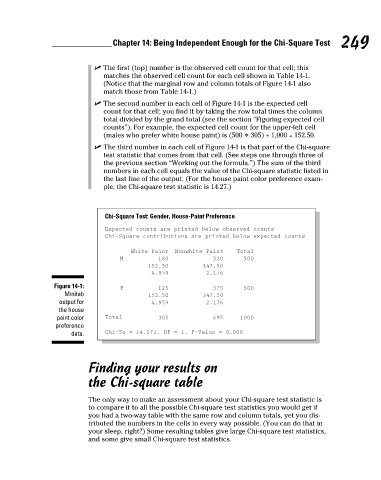
                                  ✓ The first (top) number is the observed cell count for that cell; this
                                    matches the observed cell count for each cell shown in Table 14-1.
                                    (Notice that the marginal row and column totals of Figure 14-1 also
                                    match those from Table 14-1.)
                                  ✓ The second number in each cell of Figure 14-1 is the expected cell
                                    count for that cell; you find it by taking the row total times the column
                                    total divided by the grand total (see the section “Figuring expected cell
                                    counts”). For example, the expected cell count for the upper-left cell
                                    (males who prefer white house paint) is (500 * 305) ÷ 1,000 = 152.50.
                                  ✓ The third number in each cell of Figure 14-1 is that part of the Chi-square
                                    test statistic that comes from that cell. (See steps one through three of
                                    the previous section “Working out the formula.”) The sum of the third
                                    numbers in each cell equals the value of the Chi-square statistic listed in
                                    the last line of the output. (For the house paint color preference exam-
                                    ple, the Chi-square test statistic is 14.27.)


                                     Chi-Square Test: Gender, House-Paint Preference
                                     Expected counts are printed below observed counts
                                     Chi-Square contributions are printed below expected counts

                                            White Paint  Nonwhite Paint  Total
                                         M          180            320     500
                                                 152.50         347.50
                                                  4.959          2.176
                       Figure 14-1:      F          125            375     500
                          Minitab                152.50         347.50
                        output for                4.959          2.176
                        the house
                       paint color   Total          305            695    1000
                       preference
                           data.     Chi-Sq = 14.271, DF = 1, P-Value = 0.000


                                Finding your results on

                                the Chi-square table


                                The only way to make an assessment about your Chi-square test statistic is
                                to compare it to all the possible Chi-square test statistics you would get if
                                you had a two-way table with the same row and column totals, yet you dis-
                                tributed the numbers in the cells in every way possible. (You can do that in
                                your sleep, right?) Some resulting tables give large Chi-square test statistics,
                                and some give small Chi-square test statistics.


          21_466469-ch14.indd   249                                                                   7/24/09   9:51:30 AM

