


Page 263 - Statistics II for Dummies
P. 263
Chapter 14: Being Independent Enough for the Chi-Square Test  247


                                In the gender and paint color preference example, Table 14-2 shows that all
                                the expected cell counts are at least five, so the conditions of the Chi-square
                                test are met.

                                If you’re analyzing data and you find that your data set doesn’t meet the
                                expected cell count of at least five for one or more cells, you can combine
                                some of your rows and/or columns. This combination makes your table
                                smaller, but it increases the cell counts for the cells that you do have, which
                                helps you meet the condition.


                                Calculating the Chi-square test statistic


                                Every hypothesis test uses data to make the decision about whether or not to
                                reject Ho in favor of Ha. In the case of testing for independence in a two-way
                                table, you use a hypothesis test based on the Chi-square test statistic. In the
                                following sections, you can see the steps for calculating and interpreting the
                                Chi-square test statistic, which is step five of the Chi-square test.
                                Working out the formula
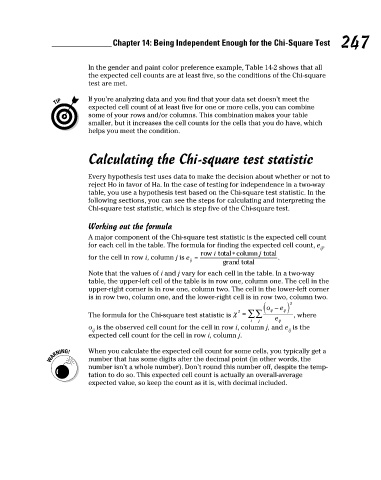
                                A major component of the Chi-square test statistic is the expected cell count
                                for each cell in the table. The formula for finding the expected cell count, e ,
                                                                                                 ij
                                for the cell in row i, column j is                   .

                                Note that the values of i and j vary for each cell in the table. In a two-way
                                table, the upper-left cell of the table is in row one, column one. The cell in the
                                upper-right corner is in row one, column two. The cell in the lower-left corner
                                is in row two, column one, and the lower-right cell is in row two, column two.

                                The formula for the Chi-square test statistic is         , where
                                o  is the observed cell count for the cell in row i, column j, and e  is the
                                 ij                                                     ij
                                expected cell count for the cell in row i, column j.
                                When you calculate the expected cell count for some cells, you typically get a
                                number that has some digits after the decimal point (in other words, the
                                number isn’t a whole number). Don’t round this number off, despite the temp-
                                tation to do so. This expected cell count is actually an overall-average
                                expected value, so keep the count as it is, with decimal included.


          21_466469-ch14.indd   247                                                                   7/24/09   9:51:29 AM

