


Page 280 - Statistics II for Dummies
P. 280
264        Part IV: Building Strong Connections with Chi-Square Tests


                      Finding the Goodness-of-Fit Statistic


                                The general idea of a goodness-of-fit procedure involves determining what
                                you expect to find and comparing it to what you actually observe in your
                                own sample through the use of a test statistic. This test statistic is called the
                                goodness-of-fit test statistic because it measures how well your model (what
                                you expected) fits your actual data (what you observed).

                                In this section, you see how to figure out the numbers that you should
                                expect in each category given your proposed model, and you also see how
                                to put those expected values together with your observed values to form the
                                goodness-of-fit test statistic.


                                What’s observed versus what’s expected


                                For an example of something that can be observed versus what’s expected,
                                look no further than a bag of tasty M&M’S Milk Chocolate Candies. A ton of
                                different kinds of M&M’S are out there, and each kind has its own variation
                                of colors and tastes. For this study, any reference I give to M&M’S is to the
                                original milk chocolate candy — my favorite.

                                The percentage of each color of M&M’S that appear in a bag is something
                                Mars (the company that makes M&M’S) spends a lot of time thinking about.
                                Mars wants specific percentages of each color in its M&M’S bags, which
                                it determines through comprehensive marketing research based on what
                                people like and want to see. Mars then posts its current percentages for each
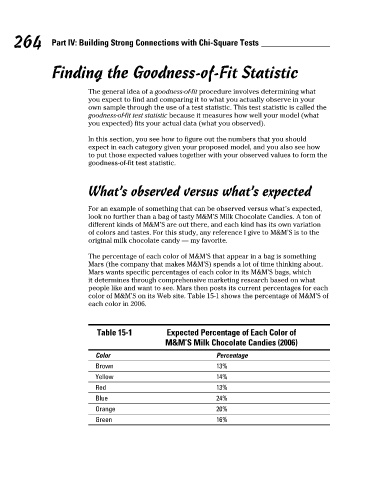
                                color of M&M’S on its Web site. Table 15-1 shows the percentage of M&M’S of
                                each color in 2006.


                                   Table 15-1         Expected Percentage of Each Color of
                                                      M&M’S Milk Chocolate Candies (2006)
                                  Color                             Percentage
                                  Brown                             13%
                                  Yellow                            14%
                                  Red                               13%
                                  Blue                              24%
                                  Orange                            20%
                                  Green                             16%


          22_466469-ch15.indd   264                                                                   7/24/09   9:52:20 AM

