


Page 283 - Statistics II for Dummies
P. 283
Chapter 15: Using Chi-Square Tests for Goodness-of-Fit  267


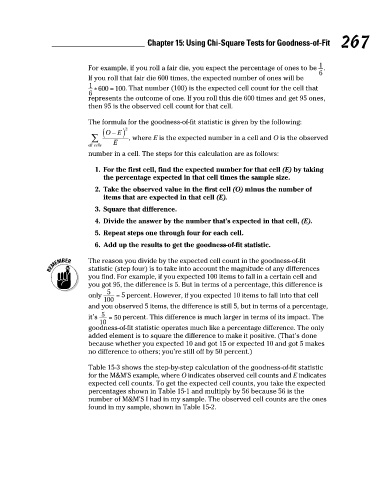
                                For example, if you roll a fair die, you expect the percentage of ones to be  .
                                If you roll that fair die 600 times, the expected number of ones will be
                                          . That number (100) is the expected cell count for the cell that
                                represents the outcome of one. If you roll this die 600 times and get 95 ones,
                                then 95 is the observed cell count for that cell.
                                The formula for the goodness-of-fit statistic is given by the following:

                                           , where E is the expected number in a cell and O is the observed

                                number in a cell. The steps for this calculation are as follows:

                                  1. For the first cell, find the expected number for that cell (E) by taking
                                    the percentage expected in that cell times the sample size.
                                  2. Take the observed value in the first cell (O) minus the number of
                                    items that are expected in that cell (E).
                                  3. Square that difference.
                                  4. Divide the answer by the number that’s expected in that cell, (E).
                                  5. Repeat steps one through four for each cell.
                                  6. Add up the results to get the goodness-of-fit statistic.

                                The reason you divide by the expected cell count in the goodness-of-fit
                                statistic (step four) is to take into account the magnitude of any differences
                                you find. For example, if you expected 100 items to fall in a certain cell and
                                you got 95, the difference is 5. But in terms of a percentage, this difference is
                                only       percent. However, if you expected 10 items to fall into that cell
                                and you observed 5 items, the difference is still 5, but in terms of a percentage,
                                it’s      percent. This difference is much larger in terms of its impact. The
                                goodness-of-fit statistic operates much like a percentage difference. The only
                                added element is to square the difference to make it positive. (That’s done
                                because whether you expected 10 and got 15 or expected 10 and got 5 makes
                                no difference to others; you’re still off by 50 percent.)

                                Table 15-3 shows the step-by-step calculation of the goodness-of-fit statistic
                                for the M&M’S example, where O indicates observed cell counts and E indicates
                                expected cell counts. To get the expected cell counts, you take the expected
                                percentages shown in Table 15-1 and multiply by 56 because 56 is the
                                number of M&M’S I had in my sample. The observed cell counts are the ones
                                found in my sample, shown in Table 15-2.


          22_466469-ch15.indd   267                                                                   7/24/09   9:52:20 AM

