


Page 285 - Statistics II for Dummies
P. 285
Chapter 15: Using Chi-Square Tests for Goodness-of-Fit  269


                                reject the model. (What constitutes a large or small value of a Chi-square test
                                statistic depends on the degrees of freedom.)

                                 The goodness-of-fit statistic follows the main characteristics of the Chi-square
                                distribution. The smallest-possible value of the goodness-of-fit statistic is
                                zero. Continuing the example from the previous section, if the M&M’S in my
                                sample followed the exact percentages found in Table 15-1, the goodness-of-fit
                                statistic would be zero. That’s because the observed counts and the expected
                                counts would be the same, so the values of the observed cell count minus the
                                expected cell count would all be zero.
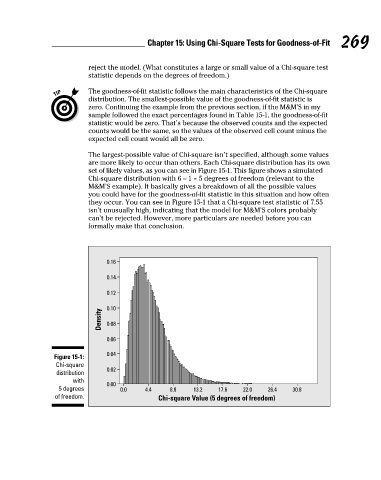
                                The largest-possible value of Chi-square isn’t specified, although some values
                                are more likely to occur than others. Each Chi-square distribution has its own
                                set of likely values, as you can see in Figure 15-1. This figure shows a simulated
                                Chi-square distribution with 6 – 1 = 5 degrees of freedom (relevant to the
                                M&M’S example). It basically gives a breakdown of all the possible values
                                you could have for the goodness-of-fit statistic in this situation and how often
                                they occur. You can see in Figure 15-1 that a Chi-square test statistic of 7.55
                                isn’t unusually high, indicating that the model for M&M’S colors probably
                                can’t be rejected. However, more particulars are needed before you can
                                formally make that conclusion.


                                     0.16

                                     0.14
                                     0.12

                                     0.10
                                    Density  0.08


                                     0.06

                                     0.04
                       Figure 15-1:
                       Chi-square
                                     0.02
                       distribution
                            with
                                     0.00
                        5 degrees        0.0    4.4    8.8   13.2   17.6   22.0   26.4   30.8
                       of freedom.                  Chi-square Value (5 degrees of freedom)


          22_466469-ch15.indd   269                                                                   7/24/09   9:52:21 AM

