


Page 500 -
P. 500
96    HAMID KAZEROONY


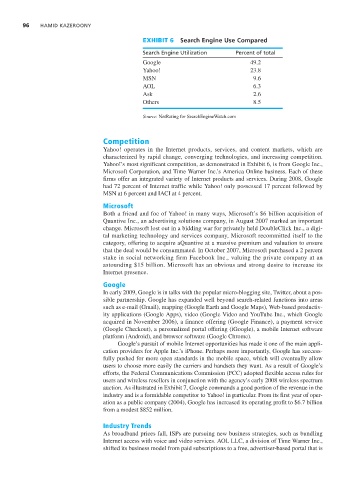
                                                   EXHIBIT 6   Search Engine Use Compared
                                                   Search Engine Utilization     Percent of total
                                                   Google                             49.2
                                                   Yahoo!                             23.8
                                                   MSN                                 9.6
                                                   AOL                                 6.3
                                                   Ask                                 2.6
                                                   Others                              8.5

                                                   Source: NetRating for SearchEngineWatch.com


                                      Competition
                                      Yahoo! operates in the Internet products, services, and content markets, which are
                                      characterized by rapid change, converging technologies, and increasing competition.
                                      Yahoo!’s most significant competition, as demonstrated in Exhibit 6, is from Google Inc.,
                                      Microsoft Corporation, and Time Warner Inc.’s America Online business. Each of these
                                      firms offer an integrated variety of Internet products and services. During 2008, Google
                                      had 72 percent of Internet traffic while Yahoo! only possessed 17 percent followed by
                                      MSN at 6 percent and IACI at 4 percent.
                                      Microsoft
                                      Both a friend and foe of Yahoo! in many ways, Microsoft’s $6 billion acquisition of
                                      Quantive Inc., an advertising solutions company, in August 2007 marked an important
                                      change. Microsoft lost out in a bidding war for privately held DoubleClick Inc., a digi-
                                      tal marketing technology and services company, Microsoft recommitted itself to the
                                      category, offering to acquire aQuantive at a massive premium and valuation to ensure
                                      that the deal would be consummated. In October 2007, Microsoft purchased a 2 percent
                                      stake in social networking firm Facebook Inc., valuing the private company at an
                                      astounding $15 billion. Microsoft has an obvious and strong desire to increase its
                                      Internet presence.

                                      Google
                                      In early 2009, Google is in talks with the popular micro-blogging site, Twitter, about a pos-
                                      sible partnership. Google has expanded well beyond search-related functions into areas
                                      such as e-mail (Gmail), mapping (Google Earth and Google Maps), Web-based productiv-
                                      ity applications (Google Apps), video (Google Video and YouTube Inc., which Google
                                      acquired in November 2006), a finance offering (Google Finance), a payment service
                                      (Google Checkout), a personalized portal offering (iGoogle), a mobile Internet software
                                      platform (Android), and browser software (Google Chrome).
                                          Google’s pursuit of mobile Internet opportunities has made it one of the main appli-
                                      cation providers for Apple Inc.’s iPhone. Perhaps more importantly, Google has success-
                                      fully pushed for more open standards in the mobile space, which will eventually allow
                                      users to choose more easily the carriers and handsets they want. As a result of Google’s
                                      efforts, the Federal Communications Commission (FCC) adopted flexible access rules for
                                      users and wireless resellers in conjunction with the agency’s early 2008 wireless spectrum
                                      auction. As illustrated in Exhibit 7, Google commands a good portion of the revenue in the
                                      industry and is a formidable competitor to Yahoo! in particular. From its first year of oper-
                                      ation as a public company (2004), Google has increased its operating profit to $6.7 billion
                                      from a modest $852 million.

                                      Industry Trends
                                      As broadband prices fall, ISPs are pursuing new business strategies, such as bundling
                                      Internet access with voice and video services. AOL LLC, a division of Time Warner Inc.,
                                      shifted its business model from paid subscriptions to a free, advertiser-based portal that is

