


Page 191 - Materials Chemistry, Second Edition
P. 191
Ch005-P373623.qxd  3/22/07  5:34 PM  Page 170
                     Sustainable Industrial Design and Waste Management
                170


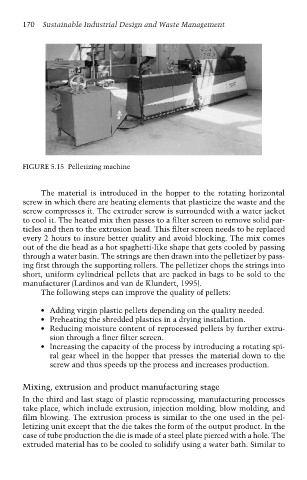
                FIGURE 5.15 Pelletizing machine


                     The material is introduced in the hopper to the rotating horizontal
                screw in which there are heating elements that plasticize the waste and the
                screw compresses it. The extruder screw is surrounded with a water jacket
                to cool it. The heated mix then passes to a filter screen to remove solid par-
                ticles and then to the extrusion head. This filter screen needs to be replaced
                every 2 hours to insure better quality and avoid blocking. The mix comes
                out of the die head as a hot spaghetti-like shape that gets cooled by passing
                through a water basin. The strings are then drawn into the pelletizer by pass-
                ing first through the supporting rollers. The pelletizer chops the strings into
                short, uniform cylindrical pellets that are packed in bags to be sold to the
                manufacturer (Lardinos and van de Klundert, 1995).
                     The following steps can improve the quality of pellets:

                     • Adding virgin plastic pellets depending on the quality needed.
                     • Preheating the shredded plastics in a drying installation.
                     • Reducing moisture content of reprocessed pellets by further extru-
                       sion through a finer filter screen.
                     • Increasing the capacity of the process by introducing a rotating spi-
                       ral gear wheel in the hopper that presses the material down to the
                       screw and thus speeds up the process and increases production.

                Mixing, extrusion and product manufacturing stage
                In the third and last stage of plastic reprocessing, manufacturing processes
                take place, which include extrusion, injection molding, blow molding, and
                film blowing. The extrusion process is similar to the one used in the pel-
                letizing unit except that the die takes the form of the output product. In the
                case of tube production the die is made of a steel plate pierced with a hole. The
                extruded material has to be cooled to solidify using a water bath. Similar to

