


Page 194 - Materials Chemistry, Second Edition
P. 194
Ch005-P373623.qxd  3/22/07  5:34 PM  Page 173
                                 Sustainability of Municipal Solid Waste Management
                                                       Exhaust                     173
                 Water                                 gases
                         Softener
                                           Boiler                            Cooling
                  Fuel
                                                                              tower
                                                                          Warm    Cold
                                              Steam
                                                                          water   water
                  Bone            Crushed           Bone
                 waste    Bone    bones    Steam    + Fat  Centrifugal  Bones
                         crusher           cooker          separator          Cooler
                                                Fat                             Bones


                                                           Packaging  Calcium
                                       Calcium powder                       Hummer mill
                                                             unit    powder
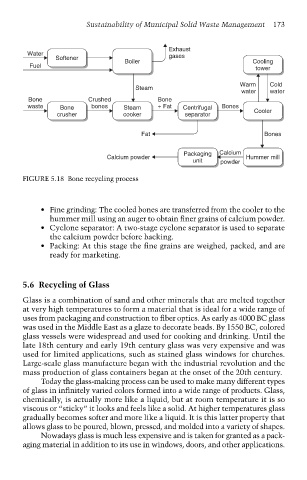
                FIGURE 5.18 Bone recycling process


                     • Fine grinding: The cooled bones are transferred from the cooler to the
                       hummer mill using an auger to obtain finer grains of calcium powder.
                     • Cyclone separator: A two-stage cyclone separator is used to separate
                       the calcium powder before backing.
                     • Packing: At this stage the fine grains are weighed, packed, and are
                       ready for marketing.


                5.6 Recycling of Glass

                Glass is a combination of sand and other minerals that are melted together
                at very high temperatures to form a material that is ideal for a wide range of
                uses from packaging and construction to fiber optics. As early as 4000 BC glass
                was used in the Middle East as a glaze to decorate beads. By 1550 BC, colored
                glass vessels were widespread and used for cooking and drinking. Until the
                late 18th century and early 19th century glass was very expensive and was
                used for limited applications, such as stained glass windows for churches.
                Large-scale glass manufacture began with the industrial revolution and the
                mass production of glass containers began at the onset of the 20th century.
                     Today the glass-making process can be used to make many different types
                of glass in infinitely varied colors formed into a wide range of products. Glass,
                chemically, is actually more like a liquid, but at room temperature it is so
                viscous or “sticky” it looks and feels like a solid. At higher temperatures glass
                gradually becomes softer and more like a liquid. It is this latter property that
                allows glass to be poured, blown, pressed, and molded into a variety of shapes.
                     Nowadays glass is much less expensive and is taken for granted as a pack-
                aging material in addition to its use in windows, doors, and other applications.

