


Page 190 - Materials Chemistry, Second Edition
P. 190
Ch005-P373623.qxd  3/22/07  5:34 PM  Page 169
                                                                                   169
                                 Sustainability of Municipal Solid Waste Management
                     In order to avoid feeding plastic films, bags, and sheets directly into a
                shredder, it is recommended to use an agglomerator that cuts, preheats, and
                dries the plastics into granules. The agglomerator will increase the mater-
                ial’s density and quality which will ensure a continuous flow in the extruder
                and hence better efficiency. It is better to clean the plastics before agglomer-
                ation since foreign substances will be processed together with the plastics.
                In the process of agglomeration, heat is added indirectly through friction
                between plastic film and the rotating blade located at the bottom of the
                agglomerator. It is therefore important to rapidly cool the plastic film to
                obtain the crumb shape desired. This is achieved through adding a small cup
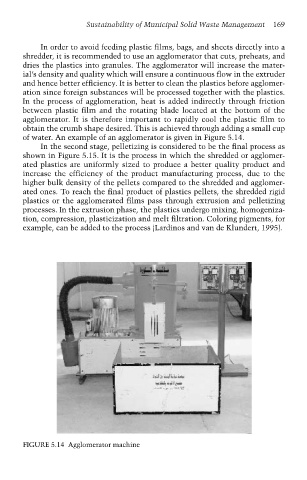
                of water. An example of an agglomerator is given in Figure 5.14.
                     In the second stage, pelletizing is considered to be the final process as
                shown in Figure 5.15. It is the process in which the shredded or agglomer-
                ated plastics are uniformly sized to produce a better quality product and
                increase the efficiency of the product manufacturing process, due to the
                higher bulk density of the pellets compared to the shredded and agglomer-
                ated ones. To reach the final product of plastics pellets, the shredded rigid
                plastics or the agglomerated films pass through extrusion and pelletizing
                processes. In the extrusion phase, the plastics undergo mixing, homogeniza-
                tion, compression, plasticization and melt filtration. Coloring pigments, for
                example, can be added to the process (Lardinos and van de Klundert, 1995).


                FIGURE 5.14 Agglomerator machine

