


Page 192 - Materials Chemistry, Second Edition
P. 192
Ch005-P373623.qxd  3/22/07  5:34 PM  Page 171
                                 Sustainability of Municipal Solid Waste Management


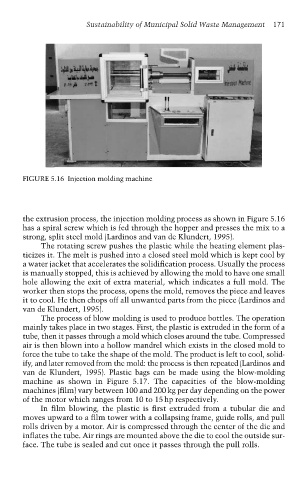
                FIGURE 5.16 Injection molding machine                              171


                the extrusion process, the injection molding process as shown in Figure 5.16
                has a spiral screw which is fed through the hopper and presses the mix to a
                strong, split steel mold (Lardinos and van de Klundert, 1995).
                     The rotating screw pushes the plastic while the heating element plas-
                ticizes it. The melt is pushed into a closed steel mold which is kept cool by
                a water jacket that accelerates the solidification process. Usually the process
                is manually stopped, this is achieved by allowing the mold to have one small
                hole allowing the exit of extra material, which indicates a full mold. The
                worker then stops the process, opens the mold, removes the piece and leaves
                it to cool. He then chops off all unwanted parts from the piece (Lardinos and
                van de Klundert, 1995).
                     The process of blow molding is used to produce bottles. The operation
                mainly takes place in two stages. First, the plastic is extruded in the form of a
                tube, then it passes through a mold which closes around the tube. Compressed
                air is then blown into a hollow mandrel which exists in the closed mold to
                force the tube to take the shape of the mold. The product is left to cool, solid-
                ify, and later removed from the mold: the process is then repeated (Lardinos and
                van de Klundert, 1995). Plastic bags can be made using the blow-molding
                machine as shown in Figure 5.17. The capacities of the blow-molding
                machines (film) vary between 100 and 200 kg per day depending on the power
                of the motor which ranges from 10 to 15 hp respectively.
                     In film blowing, the plastic is first extruded from a tubular die and
                moves upward to a film tower with a collapsing frame, guide rolls, and pull
                rolls driven by a motor. Air is compressed through the center of the die and
                inflates the tube. Air rings are mounted above the die to cool the outside sur-
                face. The tube is sealed and cut once it passes through the pull rolls.

