


Page 234 - Materials Chemistry, Second Edition
P. 234
Ch006-P373623.qxd  3/22/07  5:36 PM  Page 213
                TABLE 6.6                 Recycling of Municipal Solid Waste Rejects  213
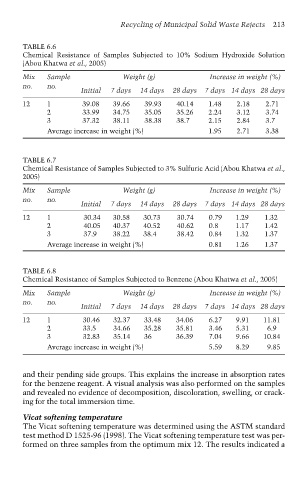
                Chemical Resistance of Samples Subjected to 10% Sodium Hydroxide Solution
                (Abou Khatwa et al., 2005)
                Mix    Sample              Weight (g)             Increase in weight (%)
                no.    no.
                                Initial  7 days  14 days  28 days  7 days 14 days 28 days
                12     1        39.08   39.66    39.93   40.14    1.48   2.18    2.71
                       2        33.99   34.75    35.05   35.26    2.24   3.12    3.74
                       3        37.32   38.11    38.38   38.7     2.15   2.84    3.7
                       Average increase in weight (%)             1.95   2.71    3.38


                TABLE 6.7
                Chemical Resistance of Samples Subjected to 3% Sulfuric Acid (Abou Khatwa et al.,
                2005)
                Mix    Sample              Weight (g)             Increase in weight (%)
                no.    no.
                                Initial  7 days  14 days  28 days  7 days 14 days 28 days
                12     1        30.34   30.58   30.73    30.74    0.79   1.29   1.32
                       2        40.05   40.37   40.52    40.62    0.8    1.17   1.42
                       3        37.9    38.22   38.4     38.42    0.84   1.32   1.37
                       Average increase in weight (%)             0.81   1.26   1.37


                TABLE 6.8
                Chemical Resistance of Samples Subjected to Benzene (Abou Khatwa et al., 2005)

                Mix    Sample              Weight (g)             Increase in weight (%)
                no.    no.
                                Initial  7 days  14 days  28 days  7 days 14 days 28 days
                12     1        30.46   32.37   33.48    34.06    6.27   9.91   11.81
                       2        33.5    34.66   35.28    35.81    3.46   5.31    6.9
                       3        32.83   35.14   36       36.39    7.04   9.66   10.84
                       Average increase in weight (%)             5.59   8.29    9.85


                and their pending side groups. This explains the increase in absorption rates
                for the benzene reagent. A visual analysis was also performed on the samples
                and revealed no evidence of decomposition, discoloration, swelling, or crack-
                ing for the total immersion time.
                Vicat softening temperature
                The Vicat softening temperature was determined using the ASTM standard
                test method D 1525-96 (1998). The Vicat softening temperature test was per-
                formed on three samples from the optimum mix 12. The results indicated a

