


Page 229 - Materials Chemistry, Second Edition
P. 229
Ch006-P373623.qxd  3/22/07  5:36 PM  Page 208
                     Sustainable Industrial Design and Waste Management
                208
                            25        Sieve 1, T   185 C  Sieve 2, T   185 C
                                      Sieve 1, T   240 C  Sieve 2, T   240 C
                            20
                           Flexural strength, MPa  15


                            10


                             5

                             0
                              20                     40                    60
                                                Sand content, %

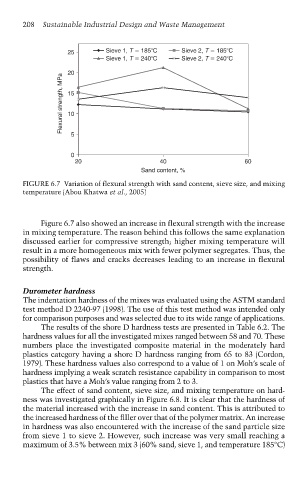
                FIGURE 6.7 Variation of flexural strength with sand content, sieve size, and mixing
                temperature (Abou Khatwa et al., 2005)


                     Figure 6.7 also showed an increase in flexural strength with the increase
                in mixing temperature. The reason behind this follows the same explanation
                discussed earlier for compressive strength; higher mixing temperature will
                result in a more homogeneous mix with fewer polymer segregates. Thus, the
                possibility of flaws and cracks decreases leading to an increase in flexural
                strength.

                Durometer hardness
                The indentation hardness of the mixes was evaluated using the ASTM standard
                test method D 2240-97 (1998). The use of this test method was intended only
                for comparison purposes and was selected due to its wide range of applications.
                     The results of the shore D hardness tests are presented in Table 6.2. The
                hardness values for all the investigated mixes ranged between 58 and 70. These
                numbers place the investigated composite material in the moderately hard
                plastics category having a shore D hardness ranging from 65 to 83 (Cordon,
                1979). These hardness values also correspond to a value of 1 on Moh’s scale of
                hardness implying a weak scratch resistance capability in comparison to most
                plastics that have a Moh’s value ranging from 2 to 3.
                     The effect of sand content, sieve size, and mixing temperature on hard-
                ness was investigated graphically in Figure 6.8. It is clear that the hardness of
                the material increased with the increase in sand content. This is attributed to
                the increased hardness of the filler over that of the polymer matrix. An increase
                in hardness was also encountered with the increase of the sand particle size
                from sieve 1 to sieve 2. However, such increase was very small reaching a
                maximum of 3.5% between mix 3 (60% sand, sieve 1, and temperature 185°C)

