


Page 224 - Materials Chemistry, Second Edition
P. 224
Ch006-P373623.qxd  3/22/07  5:36 PM  Page 203
                                          Recycling of Municipal Solid Waste Rejects
                                                                                   203
                The production of interlocks was much more profitable than brick, as they
                did not need adhesives. The cost of silica-plast interlocks is 30–50% of the
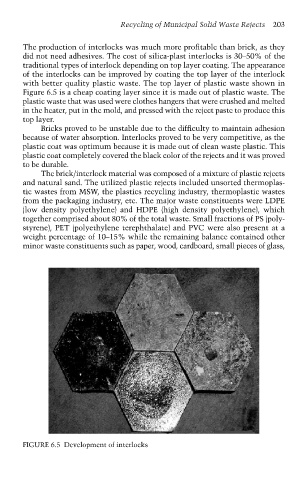
                traditional types of interlock depending on top layer coating. The appearance
                of the interlocks can be improved by coating the top layer of the interlock
                with better quality plastic waste. The top layer of plastic waste shown in
                Figure 6.5 is a cheap coating layer since it is made out of plastic waste. The
                plastic waste that was used were clothes hangers that were crushed and melted
                in the heater, put in the mold, and pressed with the reject paste to produce this
                top layer.
                     Bricks proved to be unstable due to the difficulty to maintain adhesion
                because of water absorption. Interlocks proved to be very competitive, as the
                plastic coat was optimum because it is made out of clean waste plastic. This
                plastic coat completely covered the black color of the rejects and it was proved
                to be durable.
                     The brick/interlock material was composed of a mixture of plastic rejects
                and natural sand. The utilized plastic rejects included unsorted thermoplas-
                tic wastes from MSW, the plastics recycling industry, thermoplastic wastes
                from the packaging industry, etc. The major waste constituents were LDPE
                (low density polyethylene) and HDPE (high density polyethylene), which
                together comprised about 80% of the total waste. Small fractions of PS (poly-
                styrene), PET (polyethylene terephthalate) and PVC were also present at a
                weight percentage of 10–15% while the remaining balance contained other
                minor waste constituents such as paper, wood, cardboard, small pieces of glass,


                FIGURE 6.5 Development of interlocks

