


Page 225 - Materials Chemistry, Second Edition
P. 225
Ch006-P373623.qxd  3/22/07  5:36 PM  Page 204
                     Sustainable Industrial Design and Waste Management
                204
                food scrap, cloth fragments, and small metal chips. This rejects are produced
                because of the unsorting behavior of MSW at the source which is typical in
                most developing countries and some developed countries. Inorganic siliceous
                sand with a fineness modulus (ASTM, Siere Analysis, 1998) of 3.29 was used
                as filler in the brick/interlock production. Two different sand particle sizes
                were employed, fine particles passing a 1.18 mm (No. 16) ASTM sieve and
                coarser particles passing a 2.36 mm (No. 8) ASTM sieve. The brick/interlock
                material was heated up while mixing to two temperatures, 185°C and 240°C.
                The mix was then dispatched to a steel mold and compacted using a hydraulic
                press.
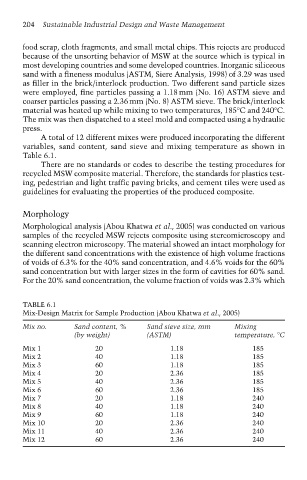
                     A total of 12 different mixes were produced incorporating the different
                variables, sand content, sand sieve and mixing temperature as shown in
                Table 6.1.
                     There are no standards or codes to describe the testing procedures for
                recycled MSW composite material. Therefore, the standards for plastics test-
                ing, pedestrian and light traffic paving bricks, and cement tiles were used as
                guidelines for evaluating the properties of the produced composite.


                Morphology
                Morphological analysis (Abou Khatwa et al., 2005) was conducted on various
                samples of the recycled MSW rejects composite using stereomicroscopy and
                scanning electron microscopy. The material showed an intact morphology for
                the different sand concentrations with the existence of high volume fractions
                of voids of 6.3% for the 40% sand concentration, and 4.6% voids for the 60%
                sand concentration but with larger sizes in the form of cavities for 60% sand.
                For the 20% sand concentration, the volume fraction of voids was 2.3% which


                TABLE 6.1
                Mix-Design Matrix for Sample Production (Abou Khatwa et al., 2005)
                Mix no.       Sand content, %    Sand sieve size, mm    Mixing
                              (by weight)        (ASTM)                 temperature, °C
                Mix 1              20                  1.18                  185
                Mix 2              40                  1.18                  185
                Mix 3              60                  1.18                  185
                Mix 4              20                  2.36                  185
                Mix 5              40                  2.36                  185
                Mix 6              60                  2.36                  185
                Mix 7              20                  1.18                  240
                Mix 8              40                  1.18                  240
                Mix 9              60                  1.18                  240
                Mix 10             20                  2.36                  240
                Mix 11             40                  2.36                  240
                Mix 12             60                  2.36                  240

