


Page 223 - Materials Chemistry, Second Edition
P. 223
Ch006-P373623.qxd  3/22/07  5:36 PM  Page 202
                     Sustainable Industrial Design and Waste Management
                202
                products may be more difficult than new ones because customers are more
                concerned with product durability and cost of maintenance. The product devel-
                opment from recycling MSW rejects is more important and challenging than
                the product development of recycling of waste because the properties of prod-
                ucts from rejects will change from one time to another due to the heterogeneous
                nature of rejects. Therefore, continuous checking is vital with appropriate qual-
                ity control and quality assurance.


                6.4 Construction Materials and Their Properties
                Bricks
                Bricks were the first application of rejects because they were the easiest to
                produce. The major problem with bricks is the adhesion problem since they
                are made from plastics and sand. Adhesive materials are very expensive,
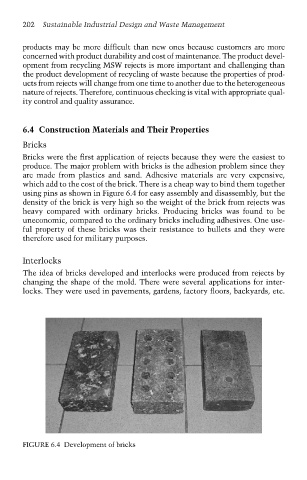
                which add to the cost of the brick. There is a cheap way to bind them together
                using pins as shown in Figure 6.4 for easy assembly and disassembly, but the
                density of the brick is very high so the weight of the brick from rejects was
                heavy compared with ordinary bricks. Producing bricks was found to be
                uneconomic, compared to the ordinary bricks including adhesives. One use-
                ful property of these bricks was their resistance to bullets and they were
                therefore used for military purposes.

                Interlocks
                The idea of bricks developed and interlocks were produced from rejects by
                changing the shape of the mold. There were several applications for inter-
                locks. They were used in pavements, gardens, factory floors, backyards, etc.


                FIGURE 6.4 Development of bricks

