


Page 226 - Materials Chemistry, Second Edition
P. 226
Ch006-P373623.qxd  3/22/07  5:36 PM  Page 205
                                                                                   205
                                          Recycling of Municipal Solid Waste Rejects
                is less than that observed in the mixes prepared at a temperature of 185°C.
                However, a 60% sand concentration prepared at 240°C revealed a volume
                fraction of voids of 7% which is higher than that observed in the mixes pre-
                pared at 185°C. For more details see Abou Khatwa et al. (2005). A comparison
                between samples prepared at a temperature of 185°C and 240°C revealed a bet-
                ter mix homogeneity for the high mixing temperature. The dispersion of the
                sand particles in the polymer matrix was enhanced and there were fewer areas
                of polymer segregation in the composite material. In addition, polymer segre-
                gation was much more pronounced in mixes containing high sand concentra-
                tions as observed by the scanning electron micrographs of these segregated
                polymeric phases. It can also be observed that weak interfacial bonds existed
                between the segregated areas and the polymeric matrix as revealed from the
                inclusions present around the segregates. Moreover, the incomplete melting
                of the recycled rejects can also be observed, which resulted in lack of diffusion
                between the fragmented plastic wastes.


                Mechanical properties
                Compressive strength
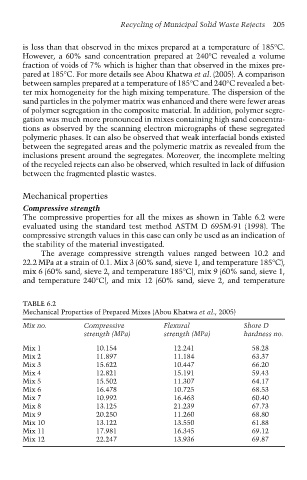
                The compressive properties for all the mixes as shown in Table 6.2 were
                evaluated using the standard test method ASTM D 695M-91 (1998). The
                compressive strength values in this case can only be used as an indication of
                the stability of the material investigated.
                     The average compressive strength values ranged between 10.2 and
                22.2 MPa at a strain of 0.1. Mix 3 (60% sand, sieve 1, and temperature 185°C),
                mix 6 (60% sand, sieve 2, and temperature 185°C), mix 9 (60% sand, sieve 1,
                and temperature 240°C), and mix 12 (60% sand, sieve 2, and temperature


                TABLE 6.2
                Mechanical Properties of Prepared Mixes (Abou Khatwa et al., 2005)
                Mix no.         Compressive           Flexural             Shore D
                                strength (MPa)        strength (MPa)       hardness no.
                Mix 1               10.154              12.241               58.28
                Mix 2               11.897              11.184               63.37
                Mix 3               15.622              10.447               66.20
                Mix 4               12.821              15.191               59.43
                Mix 5               15.502              11.307               64.17
                Mix 6               16.478              10.725               68.53
                Mix 7               10.992              16.463               60.40
                Mix 8               13.125              21.239               67.73
                Mix 9               20.250              11.260               68.80
                Mix 10              13.122              13.550               61.88
                Mix 11              17.981              16.345               69.12
                Mix 12              22.247              13.936               69.87

