


Page 231 - Materials Chemistry, Second Edition
P. 231
Ch006-P373623.qxd  3/22/07  5:36 PM  Page 210
                     Sustainable Industrial Design and Waste Management
                210
                     The results for abrasion tests conducted on the group of samples pre-
                pared at 240°C using sieve 2 with different sand contents are shown in Table
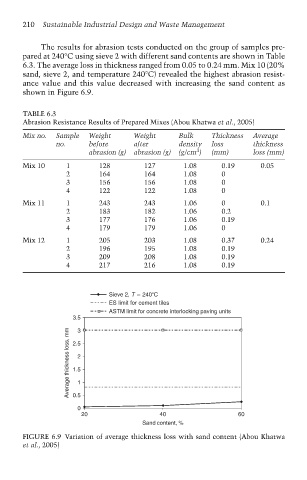
                6.3. The average loss in thickness ranged from 0.05 to 0.24 mm. Mix 10 (20%
                sand, sieve 2, and temperature 240°C) revealed the highest abrasion resist-
                ance value and this value decreased with increasing the sand content as
                shown in Figure 6.9.


                TABLE 6.3
                Abrasion Resistance Results of Prepared Mixes (Abou Khatwa et al., 2005)

                Mix no.  Sample   Weight      Weight      Bulk    Thickness  Average
                         no.      before      after       density  loss      thickness
                                                              3
                                  abrasion (g)  abrasion (g)  (g/cm )  (mm)  loss (mm)
                Mix 10      1       128         127        1.08      0.19      0.05
                            2       164         164        1.08      0
                            3       156         156        1.08      0
                            4       122         122        1.08      0
                Mix 11      1       243         243        1.06      0         0.1
                            2       183         182        1.06      0.2
                            3       177         176        1.06      0.19
                            4       179         179        1.06      0
                Mix 12      1       205         203        1.08      0.37      0.24
                            2       196         195        1.08      0.19
                            3       209         208        1.08      0.19
                            4       217         216        1.08      0.19


                                       Sieve 2, T   240 C
                                       ES limit for cement tiles
                                       ASTM limit for concrete interlocking paving units
                             3.5 3
                            Average thickness loss, mm  2.5 2 1


                             1.5


                             0.5
                               0
                                20                   40                  60
                                                Sand content, %

                FIGURE 6.9 Variation of average thickness loss with sand content (Abou Khatwa
                et al., 2005)

