


Page 232 - Materials Chemistry, Second Edition
P. 232
Ch006-P373623.qxd  3/22/07  5:36 PM  Page 211
                                          Recycling of Municipal Solid Waste Rejects
                                                                                   211
                     Abrasive wear is the natural consequence of the shearing of junctions
                between surfaces caused by the introduction of abrasive particles from out-
                side; by using soft plastics, the abrasive particles will sink below the surface
                resulting in no further harm (Cordon, 1979). Thus, increasing the polymeric
                content on behalf of the filler reduces abrasive wear and seizure can be com-
                pletely avoided. Moreover, when there is a weak adhesive bond between the
                filler and the polymeric matrix, fillers will increase the rate of wear of the
                material due to the ease with which the filler gets separated from the matrix.
                Hence, increasing the sand content will decrease the resistance to abrasion.
                     Regardless of the differences encountered in the average thickness loss
                between the mixes, the highest value of 0.24 mm for mix 12 (60% sand, sieve
                2, and temperature 240°C) was 70% lower than the Egyptian standard limit
                for cement tiles, and 92% lower than the ASTM standard limit for solid con-
                crete interlocking paving units. Hence, all mixes reveal an excellent abrasion
                resistance.

                Density and water absorption
                The density of all the prepared mixes was determined using procedure A of the
                ASTM standard test method D 792-91 (1998). The relative rate of absorption of
                water for all mixes was evaluated by the 24 hour immersion procedure of the
                ASTM standard test method D 570-95 (1998) for water absorption of plastics.
                     The average density and water absorption results of the different mixes
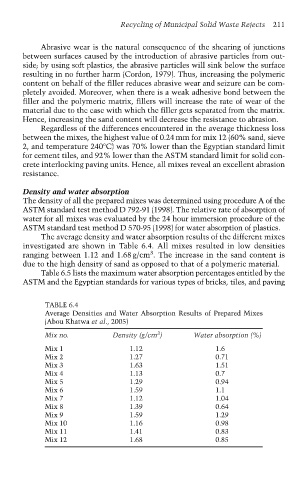
                investigated are shown in Table 6.4. All mixes resulted in low densities
                                                  3
                ranging between 1.12 and 1.68 g/cm . The increase in the sand content is
                due to the high density of sand as opposed to that of a polymeric material.
                     Table 6.5 lists the maximum water absorption percentages entitled by the
                ASTM and the Egyptian standards for various types of bricks, tiles, and paving


                      TABLE 6.4
                      Average Densities and Water Absorption Results of Prepared Mixes
                      (Abou Khatwa et al., 2005)
                                                    3
                      Mix no.           Density (g/cm )       Water absorption (%)
                      Mix 1                  1.12                  1.6
                      Mix 2                  1.27                  0.71
                      Mix 3                  1.63                  1.51
                      Mix 4                  1.13                  0.7
                      Mix 5                  1.29                  0.94
                      Mix 6                  1.59                  1.1
                      Mix 7                  1.12                  1.04
                      Mix 8                  1.39                  0.64
                      Mix 9                  1.59                  1.29
                      Mix 10                 1.16                  0.98
                      Mix 11                 1.41                  0.83
                      Mix 12                 1.68                  0.85

