


Page 230 - Materials Chemistry, Second Edition
P. 230
Ch006-P373623.qxd  3/22/07  5:36 PM  Page 209
                            75            Recycling of Municipal Solid Waste Rejects  209
                                      Sieve 1, T   185 C   Sieve 2, T   185 C
                                      Sieve 1, T   240 C   Sieve 2, T   240 C
                          Durometer hardness no., shore D  65
                            70


                            60


                            55


                            50
                              20                     40                    60
                                                Sand content, %
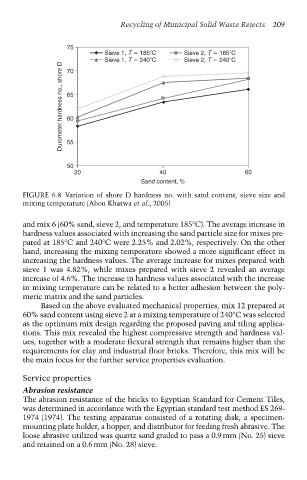
                FIGURE 6.8 Variation of shore D hardness no. with sand content, sieve size and
                mixing temperature (Abou Khatwa et al., 2005)

                and mix 6 (60% sand, sieve 2, and temperature 185°C). The average increase in
                hardness values associated with increasing the sand particle size for mixes pre-
                pared at 185°C and 240°C were 2.25% and 2.02%, respectively. On the other
                hand, increasing the mixing temperature showed a more significant effect in
                increasing the hardness values. The average increase for mixes prepared with
                sieve 1 was 4.82%, while mixes prepared with sieve 2 revealed an average
                increase of 4.6%. The increase in hardness values associated with the increase
                in mixing temperature can be related to a better adhesion between the poly-
                meric matrix and the sand particles.
                     Based on the above evaluated mechanical properties, mix 12 prepared at
                60% sand content using sieve 2 at a mixing temperature of 240°C was selected
                as the optimum mix design regarding the proposed paving and tiling applica-
                tions. This mix revealed the highest compressive strength and hardness val-
                ues, together with a moderate flexural strength that remains higher than the
                requirements for clay and industrial floor bricks. Therefore, this mix will be
                the main focus for the further service properties evaluation.

                Service properties
                Abrasion resistance
                The abrasion resistance of the bricks to Egyptian Standard for Cement Tiles,
                was determined in accordance with the Egyptian standard test method ES 269-
                1974 (1974). The testing apparatus consisted of a rotating disk, a specimen-
                mounting plate holder, a hopper, and distributor for feeding fresh abrasive. The
                loose abrasive utilized was quartz sand graded to pass a 0.9 mm (No. 25) sieve
                and retained on a 0.6 mm (No. 28) sieve.

