


Page 335 -
P. 335
302     Part 4  •  the essentials of Design

                                            on which organizational members base their decisions is determined by what analysts perceive
                                            is important to the business.
                                               Bias is present in everything that humans create. This statement is not to judge bias as bad
                                            but to make the point that it is inseparable from what we (and consequently our systems) pro-
                                            duce. The concerns of systems analysts are to avoid unnecessarily biasing output and to make
                                            users aware of the possible biases in the output they receive.
                                               Presentations of output are unintentionally biased in three main ways:

                                              1. How information is sorted
                                              2. Setting of acceptable limits
                                              3. Choice of graphics


                                            inTrodUcing bias When inforMaTion is sorTed.  Bias is introduced to output when analysts
                                            and users make choices about how information is sorted for a report. Common sorts include
                                            alphabetical, chronological, and cost.
                                               Information presented alphabetically may overemphasize the items that begin with the let-
                                            ters A and B because users tend to pay more attention to information presented first. For example,
                                            if past suppliers are listed alphabetically, companies such as Aardvark Printers, Advent Supplies,
                                            and Barkley Office Equipment are shown to the purchasing manager first. When certain airlines
                                            created the SABRE and APOLLO reservations systems, they listed their own flights first, until
                                            the other airlines complained that this type of sorting was biased.
                                            inTrodUcing  bias by  seTTing  liMiTs.  A second major source of bias in output is the
                                            predefinition of limits for particular values being reported. Many reports are generated on an
                                            exception basis only, which means that when limits on values are set beforehand, only exceptions
                                            to those values will be output. Exception reports make the decision maker aware of deviations
                                            from satisfactory values.
                                               For example, limits that are set too low for exception reports can bias the user’s percep-
                                            tion. An insurance company that generates exception reports on all accounts one week overdue
                                            has set too low a limit on overdue payments. The decision maker receiving the output will be
                                            overwhelmed with “exceptions” that are not really cause for concern. The one-week overdue
                                            exception report leads to the user’s misperception that there are a great many overdue accounts.
                                            A more appropriate limit for generating an exception report would be accounts 30 days or more
                                            overdue.

                                            inTrodUcing bias ThroUgh graphics.  Output is subject to a third type of presentation bias,
                                            which is brought about by an analyst’s (or users’) choice of graphics for output display. Bias can
                                            occur in the selection of the graph size, its color, the scale used, and even the type of graphic.
                                               Graph size must be proportional so that the user is not biased as to the importance of the
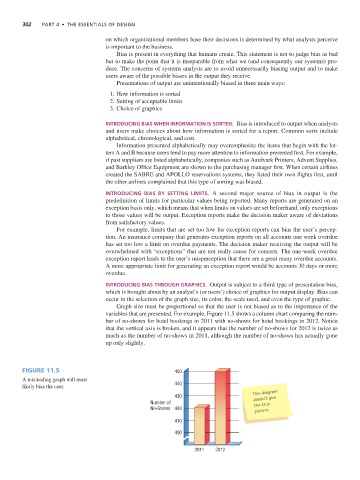
                                            variables that are presented. For example, Figure 11.5 shows a column chart comparing the num-
                                            ber of no-shows for hotel bookings in 2011 with no-shows for hotel bookings in 2012. Notice
                                            that the vertical axis is broken, and it appears that the number of no-shows for 2012 is twice as
                                            much as the number of no-shows in 2011, although the number of no-shows has actually gone
                                            up only slightly.


                Figure 11.5                                       450
                A misleading graph will most
                likely bias the user.                             440
                                                                                            This diagram
                                                                  430                       doesn’t give
                                                          Number of                          the true
                                                          No-Shows 420                       picture.

                                                                  410

                                                                  400

                                                                         2011   2012

