


Page 325 - Bruce Ellig - The Complete Guide to Executive Compensation (2007)
P. 325
Chapter 6. Employee Benefits and Perquisites            311


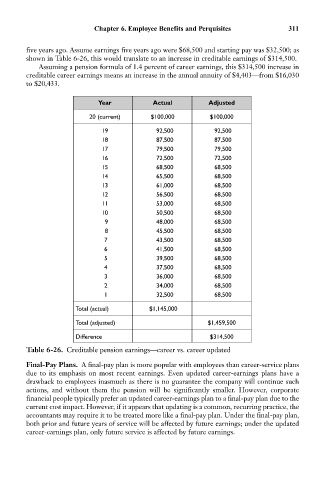
           five years ago. Assume earnings five years ago were $68,500 and starting pay was $32,500; as
           shown in Table 6-26, this would translate to an increase in creditable earnings of $314,500.
               Assuming a pension formula of 1.4 percent of career earnings, this $314,500 increase in
           creditable career earnings means an increase in the annual annuity of $4,403—from $16,030
           to $20,433.

                                Year           Actual          Adjusted

                             20 (current)      $100,000         $100,000
                                 19             92,500           92,500
                                 18             87,500           87,500
                                 17             79,500           79,500
                                 16             72,500           72,500
                                 15             68,500           68,500
                                 14             65,500           68,500
                                 13             61,000           68,500
                                 12             56,500           68,500
                                 11             53,000           68,500
                                 10             50,500           68,500
                                  9             48,000           68,500
                                  8             45,500           68,500
                                 7              43,500           68,500
                                 6              41,500           68,500
                                 5              39,500           68,500
                                 4              37,500           68,500
                                 3              36,000           68,500
                                 2              34,000           68,500
                                 1              32,500           68,500

                         Total (actual)       $1,145,000
                         Total (adjusted)                      $1,459,500

                         Difference                             $314,500
           Table 6-26. Creditable pension earnings—career vs. career updated

           Final-Pay Plans. A final-pay plan is more popular with employees than career-service plans
           due to its emphasis on most recent earnings. Even updated career-earnings plans have a
           drawback to employees inasmuch as there is no guarantee the company will continue such
           actions, and without them the pension will be significantly smaller. However, corporate
           financial people typically prefer an updated career-earnings plan to a final-pay plan due to the
           current cost impact. However, if it appears that updating is a common, recurring practice, the
           accountants may require it to be treated more like a final-pay plan. Under the final-pay plan,
           both prior and future years of service will be affected by future earnings; under the updated
           career-earnings plan, only future service is affected by future earnings.

