


Page 295 - Thomson, William Tyrrell-Theory of Vibration with Applications-Taylor _ Francis (2010)
P. 295
282                             Vibration of Continuous Systems   Chap. 9

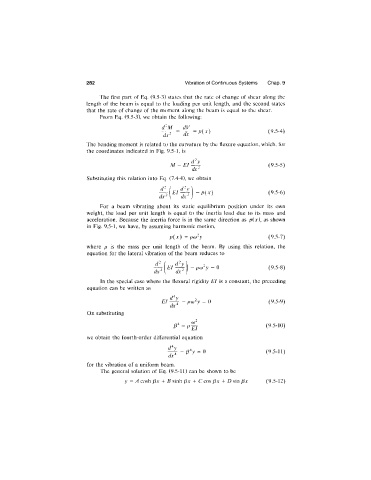
                                  The  first part of Eq.  (9.5-3) states that  the  rate  of change of shear  along the
                              length  of the  beam  is  equal  to  the  loading  per  unit  length,  and  the  second  states
                              that the  rate of change of the  moment  along the  beam  is equal  to the  shear.
                                  From  Eq. (9.5-3), we obtain  the following:
                                                              dV
                                                                                          (9.5-4)
                                                       d\:^
                              The bending moment is related to the curvature by the flexure equation, which, for
                              the  coordinates  indicated  in  Fig.  9.5-1,  is
                                                                d^y
                                                         M =  El                          (9.5-5)
                                                                dx^
                              Substituting this relation  into  Eq, (7.4-4), we obtain
                                                      d^
                                                                                          (9.5-6)
                                                      dx'
                                  For  a  beam  vibrating  about  its  static  equilibrium  position  under  its  own
                              weight,  the  load  per  unit  length  is  equal  to  the  inertia  load  due  to  its  mass  and
                              acceleration.  Because  the  inertia  force  is  in  the  same  direction  as  p{x),  as  shown
                              in Fig. 9.5-1, we  have, by assuming harmonic motion.
                                                         p{x)  = pw^y                     (9.5-7)
                              where  p  is  the  mass  per  unit  length  of  the  beam.  By  using  this  relation,  the
                              equation for the  lateral vibration  of the beam  reduces to

                                                                                          (9.5-8)
                                                    dx^
                                  In the special case where the flexural rigidity El  is a constant, the preceding
                              equation can be written  as

                                                       E/    -  pw  y  =  0               (9.5-9)
                                                         ax
                              On substituting
                                                                                         (9.5-10)

                              we obtain  the fourth-order differential  equation

                                                               « 4  0                    (9.5-11)

                              for the vibration  of a uniform beam.
                                  The  general solution of Eq  (9.5-11) can be  shown  to be
                                          y  = A cosh (3x  + B sinh /3x  +  C cos ¡3x   D sin ^x  (9.5-12)

