


Page 384 - Thermal Hydraulics Aspects of Liquid Metal Cooled Nuclear Reactors
P. 384
(U)RANS pool thermal hydraulics                                   347


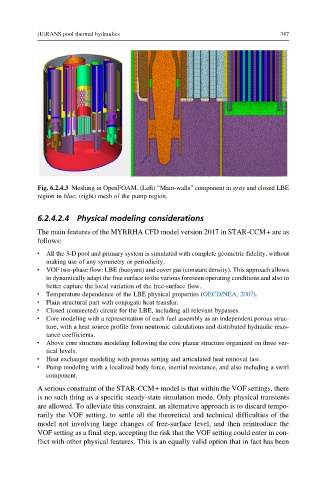
           Fig. 6.2.4.3 Meshing in OpenFOAM. (Left) “Main-walls” component in gray and closed LBE
           region in blue; (right) mesh of the pump region.

           6.2.4.2.4 Physical modeling considerations

           The main features of the MYRRHA CFD model version 2017 in STAR-CCM+ are as
           follows:

           l  All the 3-D pool and primary system is simulated with complete geometric fidelity, without
              making use of any symmetry or periodicity.
           l  VOF two-phase flow: LBE (buoyant) and cover gas (constant density). This approach allows
              to dynamically adapt the free surface to the various foreseen operating conditions and also to
              better capture the local variation of the free-surface flow.
           l  Temperature dependence of the LBE physical properties (OECD/NEA, 2007).
           l  Plain structural part with conjugate heat transfer.
           l  Closed (connected) circuit for the LBE, including all relevant bypasses.
           l  Core modeling with a representation of each fuel assembly as an independent porous struc-
              ture, with a heat source profile from neutronic calculations and distributed hydraulic resis-
              tance coefficients.
           l  Above core structure modeling following the core planar structure organized on three ver-
              tical levels.
              Heat exchanger modeling with porous setting and articulated heat removal law.
           l
              Pump modeling with a localized body force, inertial resistance, and also including a swirl
           l
              component.
           A serious constraint of the STAR-CCM+ model is that within the VOF settings, there
           is no such thing as a specific steady-state simulation mode. Only physical transients
           are allowed. To alleviate this constraint, an alternative approach is to discard tempo-
           rarily the VOF setting, to settle all the theoretical and technical difficulties of the
           model not involving large changes of free-surface level, and then reintroduce the
           VOF setting as a final step, accepting the risk that the VOF setting could enter in con-
           flict with other physical features. This is an equally valid option that in fact has been

