


Page 389 - Thermal Hydraulics Aspects of Liquid Metal Cooled Nuclear Reactors
P. 389
352                   Thermal Hydraulics Aspects of Liquid Metal Cooled Nuclear Reactors

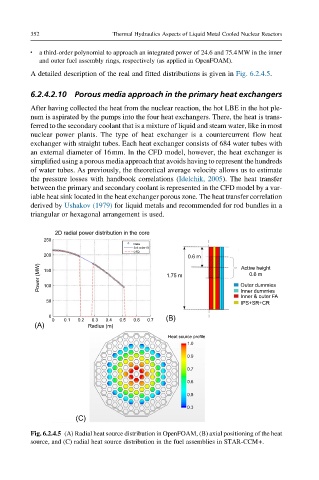
            a third-order polynomial to approach an integrated power of 24.6 and 75.4MW in the inner
         l
            and outer fuel assembly rings, respectively (as applied in OpenFOAM).
         A detailed description of the real and fitted distributions is given in Fig. 6.2.4.5.

         6.2.4.2.10 Porous media approach in the primary heat exchangers

         After having collected the heat from the nuclear reaction, the hot LBE in the hot ple-
         num is aspirated by the pumps into the four heat exchangers. There, the heat is trans-
         ferred to the secondary coolant that is a mixture of liquid and steam water, like in most
         nuclear power plants. The type of heat exchanger is a countercurrent flow heat
         exchanger with straight tubes. Each heat exchanger consists of 684 water tubes with
         an external diameter of 16mm. In the CFD model, however, the heat exchanger is
         simplified using a porous media approach that avoids having to represent the hundreds
         of water tubes. As previously, the theoretical average velocity allows us to estimate
         the pressure losses with handbook correlations (Idelchik, 2005). The heat transfer
         between the primary and secondary coolant is represented in the CFD model by a var-
         iable heat sink located in the heat exchanger porous zone. The heat transfer correlation
         derived by Ushakov (1979) for liquid metals and recommended for rod bundles in a
         triangular or hexagonal arrangement is used.

                2D radial power distribution in the core
             250

             200                                    0.6 m
            Power (MW)  150                   1.75 m              Outer dummies
                                                                  Active height
                                                                    0.6 m
             100
                                                                  Inner dummies
                                                                  Inner & outer FA
              50
                                                                  IPS+SR+CR
              0
               0  0.1  0.2  0.3  0.4  0.5  0.6  0.7  (B)
          (A)            Radius (m)
                                              Heat source profile
                                                    1.0
                                                    0.9
                                                    0.7
                                                    0.6
                                                    0.5
                                                    0.3
                     (C)

         Fig. 6.2.4.5 (A) Radial heat source distribution in OpenFOAM, (B) axial positioning of the heat
         source, and (C) radial heat source distribution in the fuel assemblies in STAR-CCM+.

