


Page 394 - Thermal Hydraulics Aspects of Liquid Metal Cooled Nuclear Reactors
P. 394
(U)RANS pool thermal hydraulics                                   357


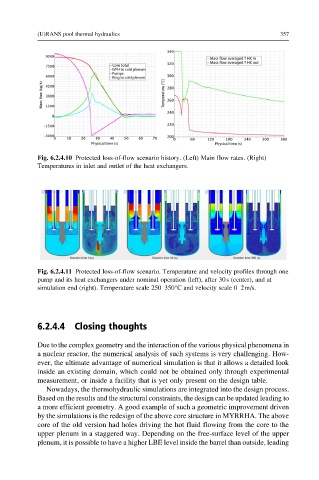
           Fig. 6.2.4.10 Protected loss-of-flow scenario history. (Left) Main flow rates. (Right)
           Temperatures in inlet and outlet of the heat exchangers.


           Fig. 6.2.4.11 Protected loss-of-flow scenario. Temperature and velocity profiles through one
           pump and its heat exchangers under nominal operation (left), after 30s (center), and at
           simulation end (right). Temperature scale 250–350°C and velocity scale 0–2m/s.


           6.2.4.4   Closing thoughts


           Due to the complex geometry and the interaction of the various physical phenomena in
           a nuclear reactor, the numerical analysis of such systems is very challenging. How-
           ever, the ultimate advantage of numerical simulation is that it allows a detailed look
           inside an existing domain, which could not be obtained only through experimental
           measurement, or inside a facility that is yet only present on the design table.
              Nowadays, the thermohydraulic simulations are integrated into the design process.
           Based on the results and the structural constraints, the design can be updated leading to
           a more efficient geometry. A good example of such a geometric improvement driven
           by the simulations is the redesign of the above core structure in MYRRHA. The above
           core of the old version had holes driving the hot fluid flowing from the core to the
           upper plenum in a staggered way. Depending on the free-surface level of the upper
           plenum, it is possible to have a higher LBE level inside the barrel than outside, leading

