


Page 395 - Thermal Hydraulics Aspects of Liquid Metal Cooled Nuclear Reactors
P. 395
358                   Thermal Hydraulics Aspects of Liquid Metal Cooled Nuclear Reactors


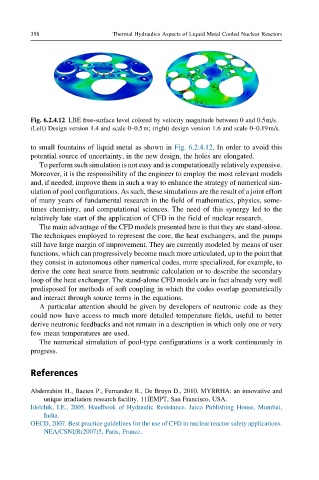
         Fig. 6.2.4.12 LBE free-surface level colored by velocity magnitude between 0 and 0.5m/s.
         (Left) Design version 1.4 and scale 0–0.5m; (right) design version 1.6 and scale 0–0.19m/s.

         to small fountains of liquid metal as shown in Fig. 6.2.4.12. In order to avoid this
         potential source of uncertainty, in the new design, the holes are elongated.
            To perform such simulation is not easy and is computationally relatively expensive.
         Moreover, it is the responsibility of the engineer to employ the most relevant models
         and, if needed, improve them in such a way to enhance the strategy of numerical sim-
         ulation of pool configurations. As such, these simulations are the result of a joint effort
         of many years of fundamental research in the field of mathematics, physics, some-
         times chemistry, and computational sciences. The need of this synergy led to the
         relatively late start of the application of CFD in the field of nuclear research.
            The main advantage of the CFD models presented here is that they are stand-alone.
         The techniques employed to represent the core, the heat exchangers, and the pumps
         still have large margin of improvement. They are currently modeled by means of user
         functions, which can progressively become much more articulated, up to the point that
         they consist in autonomous other numerical codes, more specialized, for example, to
         derive the core heat source from neutronic calculation or to describe the secondary
         loop of the heat exchanger. The stand-alone CFD models are in fact already very well
         predisposed for methods of soft coupling in which the codes overlap geometrically
         and interact through source terms in the equations.
            A particular attention should be given by developers of neutronic code as they
         could now have access to much more detailed temperature fields, useful to better
         derive neutronic feedbacks and not remain in a description in which only one or very
         few mean temperatures are used.
            The numerical simulation of pool-type configurations is a work continuously in
         progress.

         References


         Abderrahim H., Baeten P., Fernandez R., De Bruyn D., 2010. MYRRHA: an innovative and
             unique irradiation research facility. 11IEMPT, San Francisco, USA.
         Idelchik, I.E., 2005. Handbook of Hydraulic Resistance. Jaico Publishing House, Mumbai,
             India.
         OECD, 2007. Best practice guidelines for the use of CFD in nuclear reactor safety applications.
             NEA/CSNI/R(2007)5, Paris, France.

