


Page 140 - Thermodynamics of Biochemical Reactions
P. 140
7.6 Effect of  pH on Protein-Ligand Equilibria   137


                          .  .  .  .  .  .  .  .  .  .  .  . --=-:-
                                                  ---
                                                    -_
                                                  .  -_
                                                      .
                                                    .
                                                       7
                                 6         7      8        9   '  PH
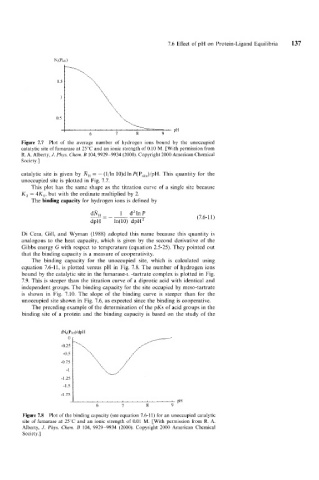
         Figure  7.7  Plot  of  the  average  number  of  hydrogen  ions  bound  by  the  unoccupied
         catatytic site of fumarase at 25°C and an ionic strength of 0.10 M. [With  permission from
         R. A. Alberty, J. Phys. Chenz. B 104,9929-9934  (2000). Copyright 2000 American Chemical
         Society.]
         catalytic  site  is  given  by  R,  = - (l/ln 10)d In P(P,,,,)/pH.  This  quantity  for  the
         unoccupied  site is plotted in Fig. 7.7.
             This plot  has  the same shape as the titration  curve of  a  single site because
         K, = 4K,,  but with the ordinate multiplied by 2.
             The binding capacity for hydrogen ions is defined by

                                  dRH  -    1  d21nP                    (7.6-1 1)
                                  dpH     ln(10)  dpH2

         Di  Cera,  Gill,  and  Wyman  (1988) adopted this  name  because  this  quantity  is
         analogous  to  the  heat  capacity, which  is  given by  the  second  derivative of  the
         Gibbs energy G with respect to temperature (equation 2.5-25). They pointed  out
         that the binding capacity is a measure of  cooperativity.
             The  binding  capacity  for  the  unoccupied  site,  which  is  calculated  using
         equation  7.6-11, is plotted versus  pH  in  Fig. 7.8. The number of  hydrogen  ions
         bound by  the catalytic site in  the fumarase-r. -tartrate complex is plotted in Fig.
         7.9. This is steeper than the  titration  curve of  a diprotic acid  with identical and
         independent groups. The binding capacity for the site occupied by meso-tartrate
         is  shown  in  Fig.  7.10. The  slope  of  the  binding  curve  is  steeper  than  for  the
         unoccupied  site shown in Fig. 7.6,  as expected since the binding is cooperative.
             The preceding example of  the determination of the pKs of  acid groups in the
         binding  site of  a protein  and the  binding capacity is  based  on the study of  the


                       -1.25
                        -1.5
                       -1.75
                                    6        7        8        9

         Figure 7.8  Plot of  the binding capacity (see equation 7.6-11) for an unoccupied catalytic
         site of  fumarase at 25°C and an ionic strength  of  0.01 M. [With  permission  from R. A.
         Alberty, J.  Phys.  Chem.  B  104, 9929-9934  (2000). Copyright 2000  American  Chemical
         Society.]

