


Page 360 - Tunable Lasers Handbook
P. 360
320     Norman P.  Barnes

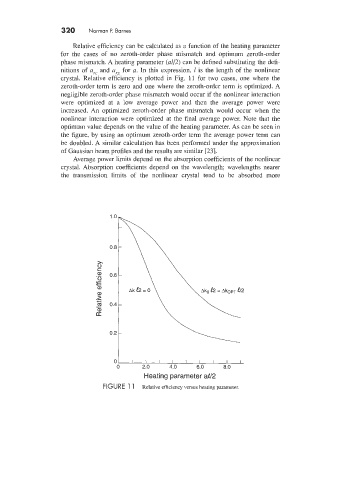
                       Relative efficiency can be calculated as a function of the heating parameter
                   for  the  cases  of  no  zeroth-order  phase  mismatch  and  optimum  zeroth-order
                   phase mismatch. A heating parameter (42) can be defined substituting the defi-
                   nitions of  arc and urs for a. In this expression, 1 is the length of  the nonlinear
                   crystal.  Relative efficiency  is plotted  in Fig.  11 for  two  cases, one where the
                   zeroth-order term is zero and one where the zeroth-order term is optimized. A
                   negligible zeroth-order phase mismatch would occur if the nonlinear interaction
                   were  optimized  at  a  low  average  power  and  then  the  average  power  were
                   increased.  An  optimized  zeroth-order  phase  mismatch  would  occur  when  the
                   nonlinear  interaction were optimized  at the final average power. Note  that the
                   optimum value depends on the value of the heating parameter. As can be seen in
                   the figure, by  using an optimum zeroth-order term the average power term can
                   be doubled. A similar calculation has been performed under the approximation
                   of Gaussian beam profiles and the results are similar [23].
                       Average power limits depend on the absorption coefficients of the nonlinear
                   crystal. Absorption coefficients depend on the  wavelength; wavelengths nearer
                   the  transmission  limits  of  the  nonlinear  crystal  tend  to  be  absorbed  more


                                  1 .o


                                  0.8
                              =-
                              0
                              c
                              -  -   0.6
                              .a,
                              .-
                              0
                              Q,
                              Q,
                              >
                              .-
                              -   0.4
                              c
                              (d
                              Q,
                              U
                                  0.2

                                   0    I   I   I   I   I   I   I   I    I
                                           2.0     4.0      6.0     8.0
                                            Heating parameter aU2
                                FIGURE 1 1   Relative efficiency versus heating parameter.

