


Page 463 - Tunable Lasers Handbook
P. 463
8  Tunable External-Cavity Serniconductoi Lasers   42

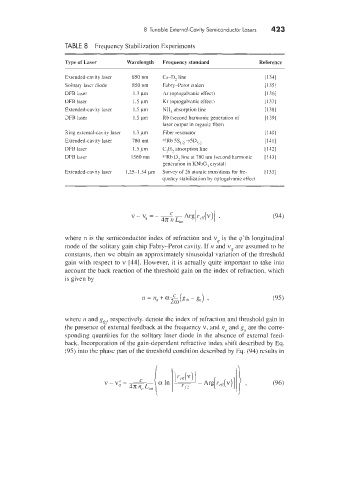
                    TABLE 8  Frequency Stabilization Experiments

                    Type of Laser      Wavelength   Frequency standard        Reference

                    Extended-cavity laser   850 nrn   Cs-D,  line
                    Solitary laser diode   850 nm   Fabq-Perot  etalon
                    DFB laser            1.3 um   Ar (optogalvanic effect)
                    DFB !aser            1.5 Fm   Kr (optogalvanic effect)
                    Extended-cavity laser   1.5 pm   NH,  absorption line
                    3FB laser            1.5 pm   Rb (second harmonic generation of
                                                 laser output in organic fiberi
                    Xing external-cavity laser   1.3 ,um   Fiber resonator
                    Extended-cavity laser   180 nm   sjRb 5S,:2+5D,,,
                    DFB laser            1.5 prn   CIH, absorption line
                    DFB laser           1560 nm   b7Rb D, line at 180 nm (second harmonic
                                                 generation in KNbO; crystalj
                    Extended-cavity laser   1.15-1.54  pm   Sumey of 26 atomic transitions for fre-
                                                 quency stabilization by  optogalvanic effect


                    where n is ithe semiconductor index of  refraction  and vq is the q'th longitudinal
                    mode of the solitary gain chip Fabry-Perot  cavity. If  tz  and vq are assumed to be
                    constants, tlhen we obtain an approximately sinusoidal variation of the threshold
                    gain with respect to v  [44]. However, it is actually quite important to take into
                    account the back reaction of the threshold gain on the index of refraction, which
                    is given by


                    where 17  and gth, respectively. denote the index of refraction and threshold gain in
                    the presence of external feedback at the frequency v. and i?o and go are the corre-
                    sponding qluantities for the  solitary laser diode in the absence  of  external feed-
                    back. Incoqporation of the gain-dependent refractive index shift described by Eq.
                    (95 j into the phase part of the threshold condition described by Eq. (94) results in

