


Page 464 - Tunable Lasers Handbook
P. 464
424     Paul Zorabedian

                   where  i;z  is the reflectance of  the feedback-coupling facet. and now the V;  are
                   the longitudinal modes of the solitary gain-chip cavity in the absence of external
                   feedback  and  thus  serve  as  constant-frequency markers. The net  effect  of  the
                   gain-dependent refractive index shift is to change the dependence of  the thresh-
                   old  gain  on  uavelength  from  a  sinusoid  to  an  asymmetric  sawtooth  pattern.
                   Depending on the values of a, rf2, and   the threshold versus wavelength can
                   be either single-valued or I-eentmrzt (Fig. 43). The condition where the threshold
                   versus wavelength curve is reentrant (or overhanging) corresponds to the condi-
                   tion of bistability  [23]. In this case wavelength bands exist that occur with the
                   periodicity of the solitary cavity longitudinal mode spacing in which the oscilla-
                   tion threshold is multivalued (actually triple valued). When the bias current is
                   turned up from zero, the laser goes into the low-threshold state. However, if  the
                   cavity is momentarily blocked while the bias current remains on, the oscillation
                   will switch to the high-threshold state when the obstruction is removed (Fig. 44).


                   16.2  Bistability and Axial Mode Instability
                      As mentioned earlier, the regions in which the threshold versus wavelength
                   curve is multivalued actually contain three sets of  threshold states. It turns  out
                   that the middle states are unstable and will not support steady-state oscillation.
                   This can be  shown by performing a classical stability analysis on the rate equa-
                   tions and determining the conditions under which the circulating field and carrier
                   density return to their steady-state solutions following a small perturbation. The
                   existence of  such classically unstable states has  been experimentally correlated
                   with a transition from single-mode to multimode output [24]. Each intermediate-
                   threshold unstable mode  lies between a pair of  high- and low-threshold modes
                   along the frequency axis [144]. For a given external reflectance reSf and linewidth
                   broadening factor a, it can be  shown that unstable states appear when the facet
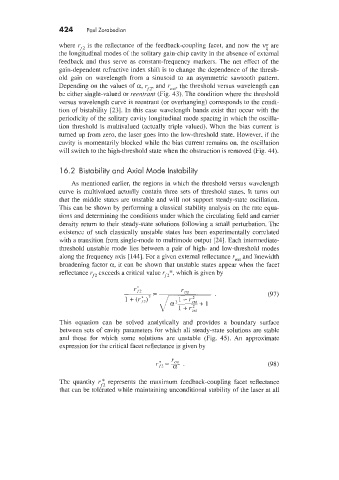
                   reflectance I-~, exceeds a critical value rf2*, which is given by


                                         I”  il


                   This  equation  can  be  solved  analytically  and  provides  a  boundary  surface
                   between sets of cavity parameters for which all steady-state solutions are stable
                   and  those  for  which  some  solutions  are  unstable  (Fig.  45). 4n approximate
                   expression for the critical facet reflectance is given by


                   The  quantity  r;  represents  the  maximum  feedback-coupling  facet  reflectance
                   that can be tolerated while maintaining unconditional stability of  the laser at all

