


Page 309 - Urban Construction Project Management
P. 309
264    Chapter Fourteen
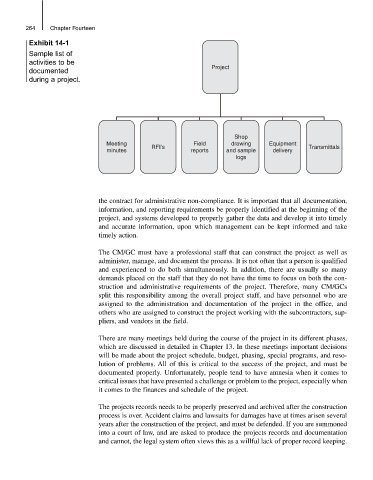
         Exhibit 14-1
         Sample list of
         activities to be
                                                            Project
         documented
         during a project.


                                                                  Shop
                               Meeting     RFI’s       Field     drawing    Equipment  Transmittals
                               minutes                reports   and sample   delivery
                                                                   logs


                            the contract for administrative non-compliance. It is important that all documentation,
                            information, and reporting requirements be properly identified at the beginning of the
                            project, and systems developed to properly gather the data and develop it into timely
                            and accurate information, upon which management can be kept informed and take
                            timely action.

                            The CM/GC must have a professional staff that can construct the project as well as
                            administer, manage, and document the process. It is not often that a person is qualified
                            and experienced to do both simultaneously. In addition, there are usually so many
                            demands placed on the staff that they do not have the time to focus on both the con-
                            struction and administrative requirements of the project.  Therefore, many CM/GCs
                            split this responsibility among the overall project staff, and have personnel who are
                            assigned to the administration and documentation of the project in the office, and
                            others who are assigned to construct the project working with the subcontractors, sup-
                            pliers, and vendors in the field.

                            There are many meetings held during the course of the project in its different phases,
                            which are discussed in detailed in Chapter 13. In these meetings important decisions
                            will be made about the project schedule, budget, phasing, special programs, and reso-
                            lution of problems. All of this is critical to the success of the project, and must be
                            documented properly. Unfortunately, people tend to have amnesia when it comes to
                            critical issues that have presented a challenge or problem to the project, especially when
                            it comes to the finances and schedule of the project.

                            The projects records needs to be properly preserved and archived after the construction
                            process is over. Accident claims and lawsuits for damages have at times arisen several
                            years after the construction of the project, and must be defended. If you are summoned
                            into a court of law, and are asked to produce the projects records and documentation
                            and cannot, the legal system often views this as a willful lack of proper record keeping.

